
Article Organizational Strategy 3 min read
Microsoft Surface Challenges Enterprise Customers
It may not happen tomorrow, but with this week’s release of Windows 8, we may be seeing the end of the desktop era as we know it. For enterprise customers, that could be a headache.
Heads up: this content is over 5 years old, so some information may be out of date.
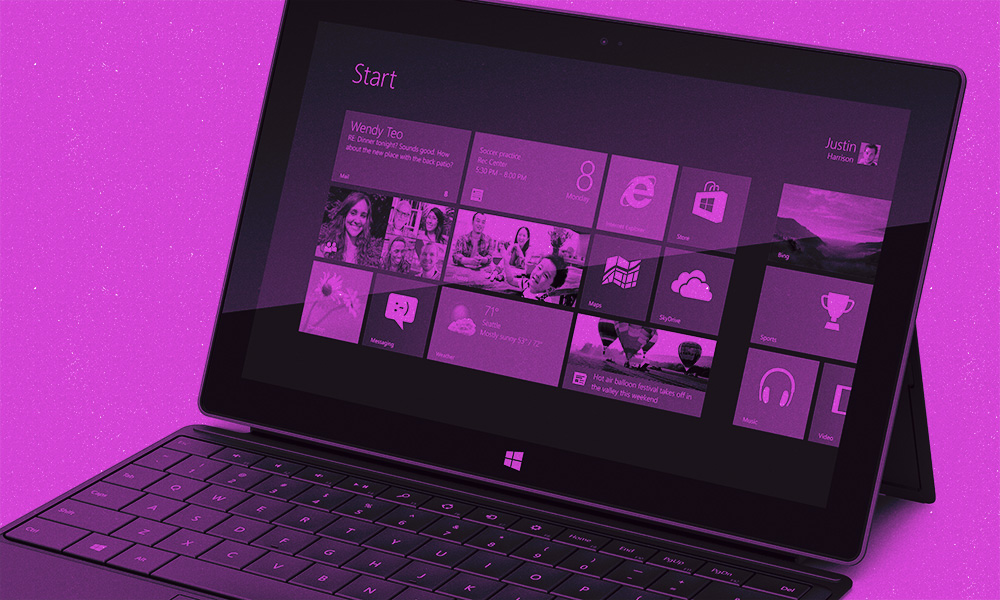
Microsoft is getting into the hardware market. This is a big deal. And a big risk.
For more than three decades, Microsoft built a legacy by becoming the de facto standard for desktop computers — first starting with DOS, then moving through numerous iterations of Windows — by licensing the software to hardware manufacturers and taking over the market.
Now, the company, feeling increasing pressure from new modes of computing like the iPad, is switching gears with Windows 8. It’s integrating its approach to something designed to work on both tablets and desktops, something that you could safely call the riskiest bet in Microsoft’s lifespan.
Some tech writers think that, even with the bold changes, they did a great job: “I have to say that I’m impressed,” writes SlashGear’s Eric Abent (opens in a new tab). “Microsoft has made a lot of really smart changes with Windows 8, and very few (if any) seem frivolous.”
But others aren’t so kind. Writing for CNET, blogger Danny Sullivan notes the split in operating systems — between the standard Windows 8 and the low-end Windows 8 RT — as severely complicating the ecosystem (opens in a new tab). And The Atlantic Wire shows that a number of average users are having trouble understanding (opens in a new tab) how to use the tablet-focused OS.
To correspond with the change, Microsoft is also on the brink of releasing the Surface tablet (opens in a new tab), which — despite relatively high prices compared with most other tablets on the market — has apparently sold briskly (opens in a new tab) ahead of its release.
Microsoft Surface Challenges Enterprise Customers
If Surface is a hit, we may find ourselves moving away from the traditional desktop paradigm entirely.
But here’s the big question for associations: No matter how impressive Windows 8 might be, does it tip too far from the needs of traditional enterprise computing?
Recently, Marc Benioff, the chairman and CEO of social enterprise company Salesforce.com, made a bold prediction about how enterprise customers would react to Windows 8. They wouldn’t, he said, and that could hasten the uptake of “bring your own device” computing.
“The next generation of leaders has come up, and the last generation is going out,” he said at last week’s Cloudforce 2012 conference, according to eWeek (opens in a new tab). “A lot of the people who made that Oracle or Microsoft [purchase] decision are no longer there. The new people in there are modern, up-to-date, and they have a new brand preference. How they view technology is different.”
Admittedly, the market is looking much more diverse these days. Beyond Microsoft, Apple is expected to release the iPad Mini later today. Last week, Google launched a super-cheap option (opens in a new tab) as part of its cloud-focused Chromebook series. Beyond that, both Amazon (opens in a new tab) and Barnes & Noble (opens in a new tab) are selling tablets significantly cheaper than the Surface.
While not all of these devices are going to raise the eyebrows of the enterprise, they all have something in common. None of these companies need Microsoft to pad their bottom line the way Dell or HP does. That is a huge change from where we were with the release of Windows XP — where Windows wasn’t just the de facto for most companies, but the default.
With Surface, Microsoft is essentially agreeing with its competitors — that top-to-bottom integration is where most big tech companies want to be, and they need a foothold on that front, too. If Surface is a hit, we may find ourselves moving away from the traditional desktop paradigm entirely.
But is the enterprise somewhere else entirely? And does Microsoft threaten to leave companies behind? Let us know what you think in the comments.
(Microsoft photo)

Comments
Comments are for ASAE members. Learn more about comments on this site.
Log in to your member account or join ASAE!