
Article Marketing / Communications 2 min read
“Shark Week” Has Researchers Fighting a Wave of Myths
For shark biologists, Discovery Channel’s annual week dedicated to the ocean prowlers is both a blessing and a curse. The president of the American Elasmobranch Society explained why.
Heads up: this content is over 5 years old, so some information may be out of date.
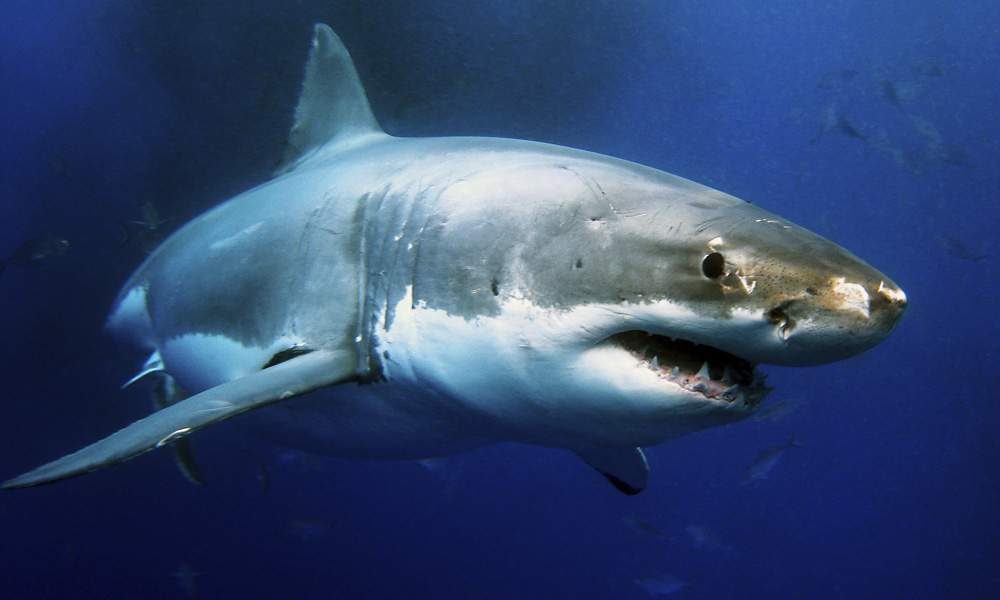
It’s safe to say that this has been the summer of the shark.
With the release of the horror-comedy Sharknado 2: The Second One (opens in a new tab) (and the confirmation that a Sharknado 3 is in the works (opens in a new tab)) and Discovery Channel’s 27th edition of “Shark Week”—which set all kinds of viewership records (opens in a new tab) last week—sharks are front and center in pop culture.
To actually do reputable shark research to confirm some of those theories is really hard.
But for all the attention the creatures get during Discovery’s week of programming, the community of shark scientists has a mixed opinion on how much good it’s actually doing.
“Elasmobrach biologists look at this as a blessing and a curse,” said Christopher G. Lowe, Ph.D., president of the American Elasmobranch Society (opens in a new tab), an organization that supports the scientific study of living and fossil sharks, rays, skates, and other ocean dwellers that belong to the elasmobranch subclass of fish. “It’s good that it brings sharks to people’s attention and makes them a household name for people who live, say, in the Midwest, who would never maybe even see a shark in their lifetime.”
The problem is that mixed with the accurate shark research presented on some programs, others take a Hollywood-style approach that plays up the dangers of sharks and fuels myths about them, said Lowe, a professor at and director of the California State University, Long Beach, Shark Lab, who has appeared on several “Shark Week” programs over the years.
“On one hand they’re saying, ‘Sharks are important and we need to do things to preserve them,’ and then on the other hand they’re saying, ‘Sharks are scary, and sharks kill people and bite people,’” he said. “You can’t have it both ways, so unfortunately for shark biologists like me, that makes ‘Shark Week’ the worst week of the year.”
It isn’t just an image problem. A lot of the theories about sharks presented on television often are taken as fact, which hurts researchers’ ability to get funding, Lowe said.
“To actually do reputable shark research to confirm some of those theories is really hard,” he said. “There’s either no funding out there, or we struggle to convince potential funders that this is research that needs to be done to validate the theories floating around out there. They think that because it appeared on ‘Shark Week’ that we already know ‘this particular thing’ about sharks, and we’re wasting time by researching it further.”
And, contrary to popular belief, the extra on-air exposure doesn’t lead to an increase in donations, said Lowe. “We don’t see any of that at all. It’s not easy to get people to rally around a creature that they’re conditioned to be afraid of.”
(iStock/Thinkstock)

Comments
Comments are for ASAE members. Learn more about comments on this site.
Log in to your member account or join ASAE!