
Passions Flare Up as Cybersecurity Bill Nears Senate Vote
Ahead of an expected vote on the Cybersecurity Information Sharing Act (CISA), tech and privacy groups are ramping up their collective pushes against the bill, saying it throws out privacy in its push for security. A key financial services group, however, says that these claims are overblown—using the text of the bill itself as its argument.
Heads up: this content is over 5 years old, so some information may be out of date.
Cybersecurity is back on the table in the Senate, and the tech world couldn’t be more frustrated by the news.
Tech groups and the companies they represent, along with digital-privacy advocates, contend that the Cybersecurity Information Sharing Act (CISA) fails at its intended mission of improving computer security through the sharing of cyberthreat warnings and endangers people’s privacy in the process. The Business Software Alliance (BSA) and the Computer & Communications Industry Association (CCIA) are among those opposing the bill.
In a blog post last week, CCIA emphasized that while it supports the goal of improving the sharing of information on cybersecurity threats between the government and the private sector, the legislation’s means of accomplishing this is insecure and ineffective.
“CISA’s prescribed mechanism for sharing of cyber threat information does not sufficiently protect users’ privacy or appropriately limit the permissible uses of information shared with the government,” the group’s Bijan Madhani stated (opens in a new tab). “In addition, the bill authorizes entities to employ network defense measures that might cause collateral harm to the systems of innocent third parties.”
BSA, meanwhile, opposes (opens in a new tab) both CISA and two other recent cybersecurity bills that passed the House, arguing that the measures need strong privacy protections. (A key BSA member, Apple, came out separately in opposition to CISA (opens in a new tab).)
The bill has led to the rise of advocacy campaigns against the legislation by key groups, including one by the Electronic Frontier Foundation (opens in a new tab) that has characterized the bill as a reawakening of the Cyber Intelligence Sharing and Protection Act (CISPA), a failed 2013 measure that drew similar passion from tech advocates.
“CISA is fundamentally flawed in its approach to cybersecurity,” EFF’s Amul Kalia wrote in a recent blog post (opens in a new tab). “Its information sharing regime wouldn’t even fix the most recent public breaches, since it doesn’t address basic problems, like unencrypted files, poor computer architecture, un-updated servers, and employees (or contractors) clicking malware links.”
An Annotated Fight
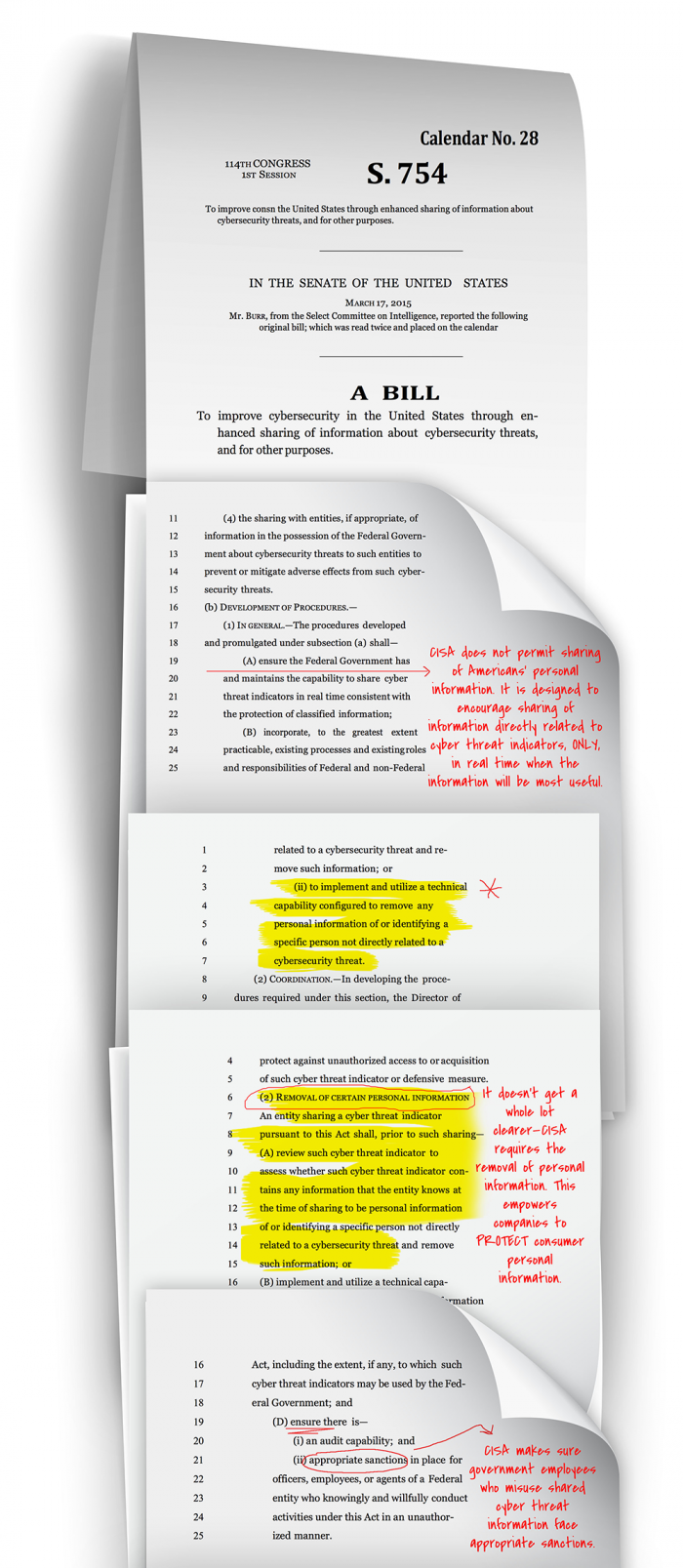
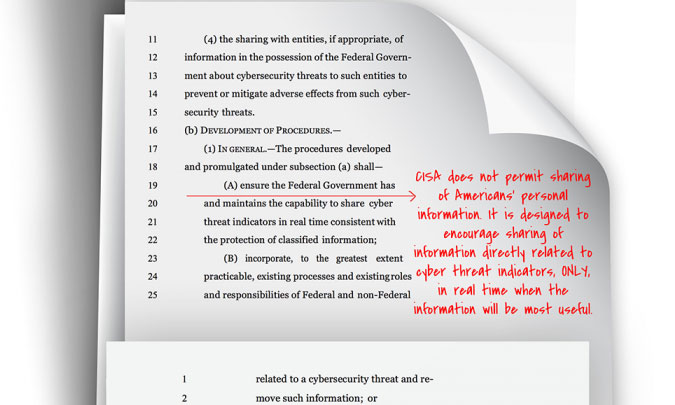
The Financial Services Roundtable (FSR), one of the key advocates supporting CISA, has pushed some campaigns of its own, including a novel infographic that annotates the text of the bill with notes emphasizing that it doesn’t endanger Americans’ security.
“It doesn’t get a whole lot clearer—CISA requires the removal of personal information,” FSR emphasizes in the infographic.
Who do you trust on privacy? Wall Street or tech experts?
Our mark-up @accessnow (opens in a new tab) @OTI (opens in a new tab) @EFF (opens in a new tab) #StopCISA (opens in a new tab) https://t.co/6yXZqqMgN2 (opens in a new tab)
@FSRoundtable— Ron Wyden (@RonWyden) October 20, 2015 (opens in a new tab)
Annotations from @CenDemTech (opens in a new tab) & @PGEddington (opens in a new tab) on our @hypothes_is (opens in a new tab) mark-up too #StopCISA (opens in a new tab)
— Ron Wyden (@RonWyden) October 20, 2015 (opens in a new tab)
But FSR wasn’t alone in coming up with this idea. Sen. Ron Wyden, the ranking member of the Finance Committee, responded by sharing more detailed annotations (opens in a new tab) [PDF] from privacy and policy advocates such as Robyn Greene of the New America Foundation and Patrick G. Eddington of the Cato Institute.
It’s an interesting way to highlight a political debate, to say the least.
A Financial Services Roundtable infographic that annotating the Cybersecurity Information Sharing Act. (Financial Services Roundtable)

Comments
Comments are for ASAE members. Learn more about comments on this site.
Log in to your member account or join ASAE!