
Article Membership 4 min read
Shifting Rules Could Shake Up Baseball Hall of Fame Voting
The National Baseball Hall of Fame’s recent decision to revoke lifetime voting rights for inactive Baseball Writers’ Association of America members could change the makeup of next year’s induction class for the Hall. Is that good or bad for players marred by the “steroid era” of baseball? Convincing 75 percent of baseball writers to agree on anything is a challenging task, but it could get a little easier in the coming years. Over the summer, the National Baseball Hall of Fame’s board made significant rule changes affecting the Baseball Writers’ Association of America (BBWAA)—the group of sports journalists that vote...
Heads up: this content is over 5 years old, so some information may be out of date.
The National Baseball Hall of Fame’s recent decision to revoke lifetime voting rights for inactive Baseball Writers’ Association of America members could change the makeup of next year’s induction class for the Hall. Is that good or bad for players marred by the “steroid era” of baseball?
Convincing 75 percent of baseball writers to agree on anything is a challenging task, but it could get a little easier in the coming years.
Over the summer, the National Baseball Hall of Fame’s board made significant rule changes affecting the Baseball Writers’ Association of America (BBWAA)—the group of sports journalists that vote on major baseball awards, including who is inducted into the Hall. Long story short: Lifetime voting rights, which allowed former sports journalists to have an impact on the game long after their retirement, are no longer; instead, only writers who are currently active members, or have been active within the last decade (opens in a new tab), will continue to have voting rights.
The rule changes, effectively the largest affecting the group in more than 60 years, reduced the voting pool significantly. Previously, writers with 10 years or more of membership in the BBWAA—approximately 650 people—could take part. (Last year, 549 members cast their ballots (opens in a new tab).) Now, with the rule change, more than 100 people who previously were allowed to vote will lose that right.
(On the other hand, players have faced tighter rules in recent years as well.)
Good for Younger Scribes
The move has gotten some mixed reviews from observers. Wayne McDonnell, the academic chair and a clinical associate professor of sports management for New York University’s Tisch Institute for Sports Management, Media, and Business, argued that the move was good for the game of baseball, as journalists more familiar with modern players and analytical strategies would have access to the voting pool. That could be a good thing for certain players, such as Jeff Bagwell and Mike Piazza, who have failed to get the required 75 percent of votes because they’ve been shut out by older voters.
“One of the greatest feelings of animosity towards the voting process rested squarely on the shoulders of electors who were no longer active but still possessed extraordinary power in bestowing baseball’s greatest honor upon a ball player,” McDonnell wrote in a recent Forbes post (opens in a new tab). “How could someone who hasn’t actively covered the sport in years honestly assess a ball player’s credentials in a day and age where comprehensive information is transmitted within seconds across several social media platforms?”
Considering that voters just two years ago failed to elect anyone to the Hall, it could lead to more recent players getting the nod.
Bad for Older Ones
On the other hand, there are concerns that the move threatens to politicize the process. In an op-ed piece for the conservative news blog The Federalist (opens in a new tab), sports journalist Steve Aschburner argued that the rule changes effectively amounted to gerrymandering in an effort to please critics such as Deadspin. He defended the role of older scribes in the voting process.
“It ought to be seen as a good thing to have voters who actually saw and in many cases covered legends such as Willie Mays, Tom Seaver, Johnny Bench, and Mike Schmidt,” wrote Aschburner. “Who better to compare today’s and tomorrow’s stars against those already enshrined, not just according to statistics but through eyewitness testimony, than veteran voters?”
Aschburner, who spent nearly two decades covering Major League Baseball but now focuses on basketball, added that he was particularly concerned that players associated with the “steroids era” of baseball, such as Mark McGwire and Sammy Sosa, could get a Hall nod, thanks to the rule change.
“Shedding older, typically more traditional Hall voters likely will carry over the trend in modern culture in which ‘judging’—making moral assessments about things like integrity and sportsmanship—often is considered worse than whatever dubious acts cause one to be judged,” Aschburner added.
Considering Steroids
Whether or not the rule changes affect voting, the rules include a character clause, which could continue to make life hard for former baseball players accused of or admitting to using steroids. Piazza, who has merely been the subject of speculation, has gotten closest to the Hall, earning 69.9 percent of the vote last year.
“It’s extremely hard. Getting 75 percent of any group to agree on anything is difficult. Players have to have impeccable stats, and with the character clause—for many people—impeccable character, too,” former BBWAA president Susan Slusser, a San Francisco Chronicle writer, told The New York Times last week (opens in a new tab).
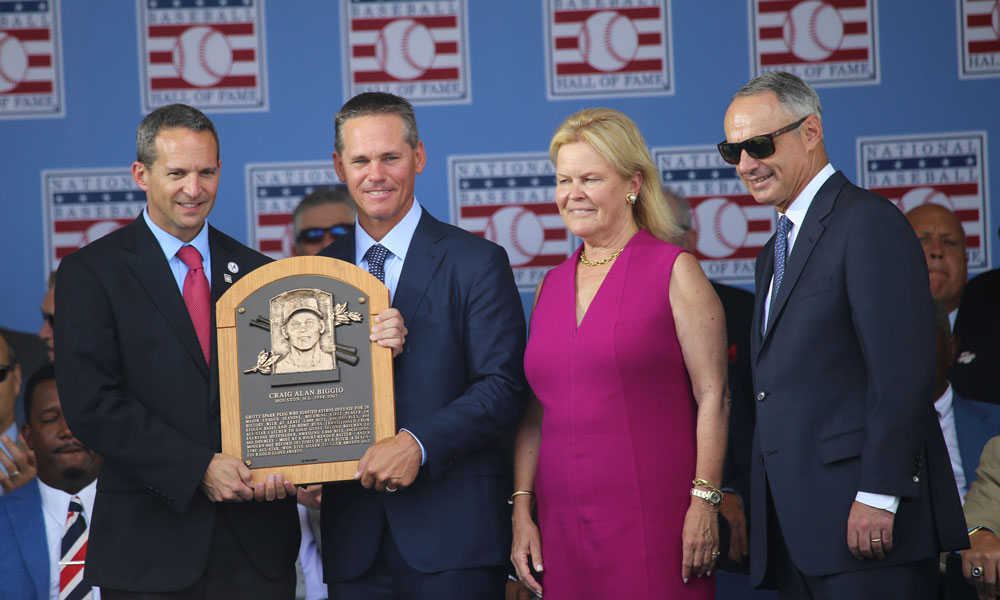
Craig Biggio, second from left, was a 2015 inductee to the National Baseball Hall of Fame. (Arturo Pardavila III/Flickr)

Comments
Comments are for ASAE members. Learn more about comments on this site.
Log in to your member account or join ASAE!