
Article Executive Leadership 3 min read
How Does Your Salary Measure Up?
Heads up: this content is over 5 years old, so some information may be out of date.

Whether you’re assessing how your organization’s compensation structure compares with others or determining what to ask for in a salary negotiation, ASAE’s 2018-2019 Association Compensation & Benefits Study, based on ASAE Foundation research offers a detailed analysis of the sector that can help you evaluate how your compensation stacks up and right-size your expectations.
In this snapshot of new data revealed in the study, which is conducted every two years, Associations Now looked at three areas: trends in CEO salaries, data on non-CEO positions, and the outlook for organization-wide merit-based raises. See how your next direct deposit measures up.
CEO Snapshot
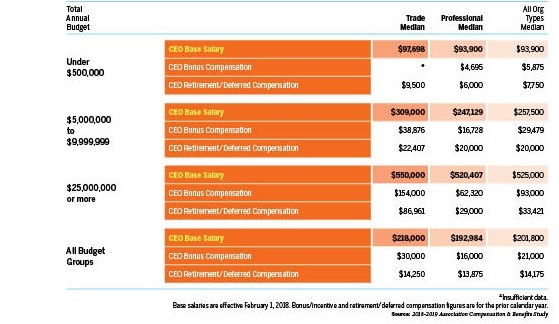
Trades pay more. The 2018 results are consistent with patterns from previous ASAE studies. On average, trade association CEOs earned at least $20,000 more than their peers at professional organizations. In addition, base salaries for CEOs, as well as bonus and deferred compensation, rose as budget size increased in all types of organizations. Here’s an overview of a few budget categories:
(Click image for larger version.)
CEO salaries static. Although the U.S. unemployment rate fell to 3.7 percent in September (opens in a new tab), a nearly 50-year low, research shows (opens in a new tab) that wages have struggled to pick up steam. And this year’s ASAE study suggests that association CEOs are facing flattening compensation.
The 2018 median for CEO base salary was less than 1 percent higher than the median reported in the 2016-2017 edition of the study, diverging from a pattern of notable growth in prior years. The median base salary for CEOs increased between 2012 and 2014—from $150,000 to $175,000—and again between 2014 and 2016—from $175,000 to $200,000.
This made for a 16.7 percent increase in base salary in 2014 and a 14.3 percent increase in 2016. By contrast, 2018 study participants reported a median base salary of $201,800, an increase of only 0.9 percent over two years ago.
According to the study, the median base salary for all association CEOs is $201,800.
But a more detailed breakdown of the data shows that the median varies depending on numerous factors, including an organization’s location, staff size and budget, industry served, and membership structure.
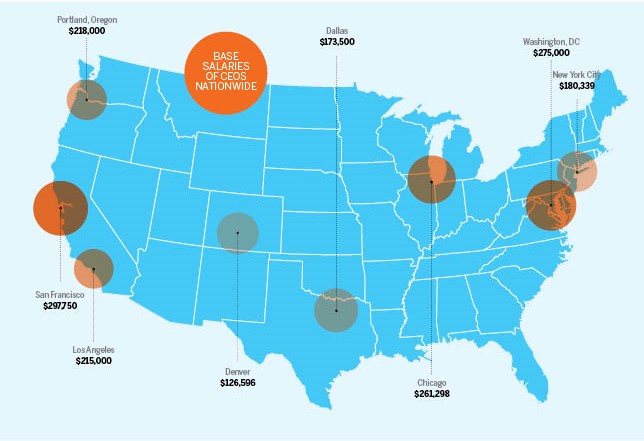
Base salaries in big cities. Here’s how median base salaries for CEOs stack up in some of the largest metropolitan areas across the country.
(Click image for larger version.)
Trends for Non-CEOs
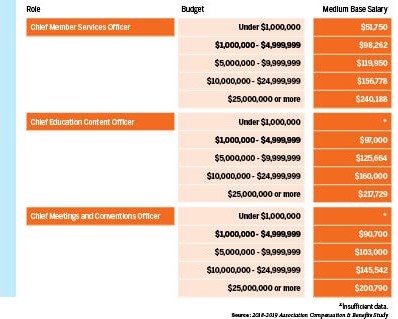
As with CEO compensation, budget size plays a large role in determining how much non-CEO positions earn. In other words, a bigger budget typically means a bigger salary. Here’s a look at the breakdown for three common association positions:
(Click image for larger version.)
Salary Increases
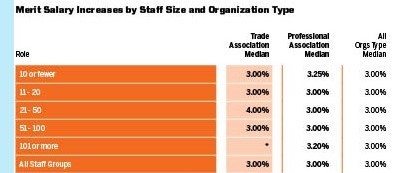
Most responding organizations said they offered different types of salary increases. The most common was merit-based increases (71.2 percent of respondents offered them). Unlike CEO compensation, merit increases didn’t vary significantly based on staff size or type of organization. And with a recent WorldatWork survey (opens in a new tab) reporting that for-profit workers can expect a 2.8 percent merit-based pay increase, associations seem to be competitive on this front.
(Click image for larger version.)
The news is even better for employees who have been promoted. The study reports that association professionals can typically expect to see a 10 percent increase when they move up in the ranks.
Dive Into the Data
- salary information on 75 different positions in associations.
- data organized by association type, size, geographic location, and other filters.
- data on various benefits provided by different types of associations across the country.
The online version, Association Compensation & Benefits Access, also allows users to apply filters to see median data for organizations like their own. For more information, visit asaecenter.org/bookstore (opens in a new tab).

Comments
Comments are for ASAE members. Learn more about comments on this site.
Log in to your member account or join ASAE!