
Lessons from Lance Armstrong’s Apology
How can association leaders learn from Lance Armstrong’s notorious brush with doping? It all comes down to telling the truth.
Heads up: this content is over 5 years old, so some information may be out of date.

Lance Armstrong let down his supporters after doping and organized team-doping accusations from the United States Anti-Doping Agency (USADA) eventually stripped him of seven Tour de France titles (opens in a new tab) and his title affiliation (opens in a new tab) to the Livestrong Foundation. Prior to the incident, which has dominated news stories since last fall, Armstrong was seen as a hero who beat the odds in the face of testicular cancer and an inspiration to many.
I will spend the rest of my life trying to earn back trust and apologize to people.
Since then, Armstrong has been called a cheat, a liar, and a disgrace to the sport of cycling, even inspiring unflattering hashtags (opens in a new tab) on Twitter.
So what can association leaders learn from Lance’s missteps? What did he do wrong, and what did he do right?
Lesson 1: Tell the Truth.
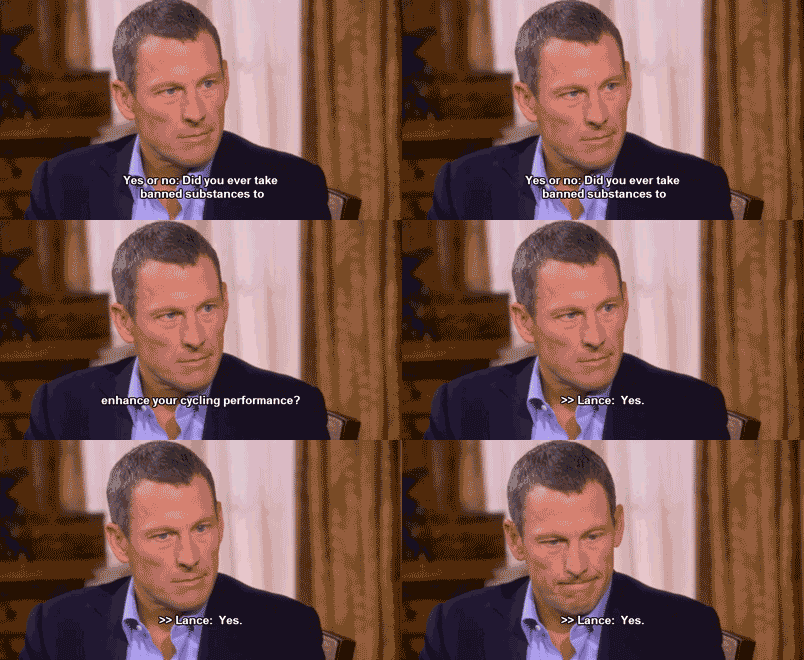
In an interview (opens in a new tab) with Oprah Winfrey last night, Armstrong finally admitted, out loud, to doping while competing in the Tour de France.
His answer “yes” to taking the banned energy substances EPO, testosterone, HGH, and cortisone and using blood-doping practices and transfusions goes back to the mid-‘90s as part of the “EPO generation,” according to an article (opens in a new tab) in the Chicago Tribune. He appeared honest and forthcoming with his answers to Oprah’s tough-as-nails approach. It looks like telling the truth has had mixed reactions (opens in a new tab), with some praising him for finally admitting what he did wrong yet others still angry.
Leaders can’t always expect a positive reaction, but coming clean, rather than hiding behind a falsified story, will always benefit your followers. (animated GIF via The Daily Dot (opens in a new tab))
Lesson 2: Tell the Truth. Right Away.
OK, so Armstrong finally came out with those key words. But the public is still largely upset with him because it took so long. Armstrong’s doping allegations go all the way back (opens in a new tab) to 1999, with outright accusations from key personnel and insistence on testing, failed tests that came up with plausible excuses, voluntary resignation in light of the scandal, and statements from Armstrong promising again and again that he never took performance-enhancing drugs (PEDs). “Armstrong acknowledges that he is too late in apologizing, and admits that he does not have a good answer as to why he was defiant and impugned the truthfulness of others,” Yahoo Sports writes (opens in a new tab).
But the fact is, Armstrong waiting so long to tell the public his real story has turned many against him. News outlets panned the interview (opens in a new tab), calling Armstrong arrogant and defiant. Does an apology matter less if it takes you a lifetime to admit it? The longer you wait to tell the truth, the less faith your followers will have in you—and the more skeptical (opens in a new tab) they become.
Armstrong sums it up in his quote: (opens in a new tab) “I will spend the rest of my life trying to earn back trust and apologize to people.”
Lesson 3: Tell the Truth. The Whole Truth.
It has since come out that Armstrong might have huge issues with his financial backers (opens in a new tab) and that he can’t even remember (opens in a new tab) the number of people he’s sued over “false” allegations in the past. Oprah asks if he’s attempted to reconcile with those he’s wronged, and Armstrong says that to many he owes an apology.
But still, organizations such as the USADA are clamoring for Armstrong to tell the truth under oath, to give up names of those who have doped for him or provided for him, and to tell the truth if any have covered up for him, which as of now he’s refusing.
Does only partly fessing up make it OK? Leaders should take note that lying by omission is still, by many accounts, lying. If there’s a paper trail, or others who deserve an apology, it’s better to be the bigger person. As we’ve seen with Armstrong, the truth will eventually come out.
What lessons are you learning from the Armstrong saga? Share with us your stories in the comments.
(George Burns/Oprah Winfrey Network handout)

Comments
Comments are for ASAE members. Learn more about comments on this site.
Log in to your member account or join ASAE!