
Article Business Development 2 min read
Azure RemoteApp: Microsoft Eyes New Windows Cloud Offerings
The tech giant's new Azure RemoteApp could offer a way for IT managers to keep their legacy Windows apps running in a mobile ecosystem. But Microsoft's platform doesn't lack competition.
Heads up: this content is over 5 years old, so some information may be out of date.
It’s not as if cloud-based server virtualization is an entirely new concept—though, it’s understandable that when Microsoft jumps in with a new offering, people take notice.
The Windows-producing giant has increasingly diversified its product portfolio to expand its cloud-based offerings on its Azure platform. This week, Microsoft announced the launch of a new turnkey service to allow companies to offer cloud-based apps at the press of a button.
Azure RemoteApp, previously code-named “Mohoro” (opens in a new tab), will work on a variety of platforms, including Mac OSX, Windows, iOS, and Android (a Windows Phone version reportedly is coming soon).
Though it has some commonalities with the company’s existing Windows Server RemoteApp, the platform is cloud-based and otherwise a bottom-up rewrite. The idea is to create something that’s scaleable based on user needs.
“Every organization I talk to has a very large inventory of Windows applications they’re looking to deliver to mobile devices,” Microsoft’s Cloud & Enterprise Division Corporate Vice President Brad Anderson said about the platform during this week’s TechEd North America Conference, according to Tech Times (opens in a new tab). “With Azure RemoteApp, users can scale up and down, so their capital expenditures goes down dramatically.”
Packed Competition
The platform’s release comes at a time when cloud-based virtualization (something the cool kids call “Desktop-as-a-Service”) is something of a hot commodity—as well as a game numerous other companies are already playing, offering similar services using Microsoft’s own Windows software.
For example, VMWare recently launched an offering for Google’s Chromebook that allows companies to run virtualized Windows machines on a ultra-cheap laptop alternative.
And last year, Amazon launched a similar service (opens in a new tab), Amazon WorkSpaces, based on the company’s widely used Web Services platform. Earlier this month, the company expanded the offering’s reach (opens in a new tab) to Europe.
Microsoft has some advantages that its competitors don’t at the moment. For one thing, Azure RemoteApp tightly integrates with its Office. But the platform also has some disadvantages, according to Pluralsight (opens in a new tab). If, for example, you need a virtual graphics processing unit (GPU) to run an application—something that might come in handy if you’re using a graphics-heavy app such as Photoshop—Azure might not be the best option as it currently lacks one. But for businesses in need of a platform for legacy Windows apps in a mobile world, it might be a good option.
The product is available in a free preview version now (opens in a new tab) for teams of up to 20 people, with a for-pay option expected to launch later this year. While the preview comes with a small number of apps, the platform eventually will allow administrators to deploy their own Windows apps.
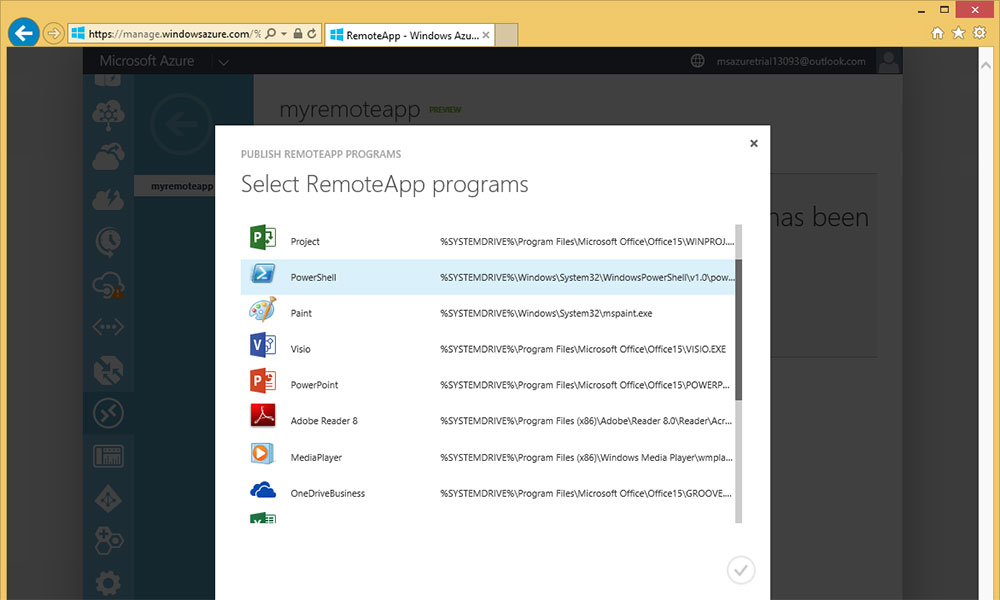
A screenshot from the Azure RemoteApp configuration screen. (photo via the Pluralsight blog)

Comments
Comments are for ASAE members. Learn more about comments on this site.
Log in to your member account or join ASAE!