
Article Membership 2 min read
Free Ride: Winter Sport Groups Help Riders With Disabilities
How a shift in thinking helped get people with disabilities on the ski slopes.
Heads up: this content is over 5 years old, so some information may be out of date.
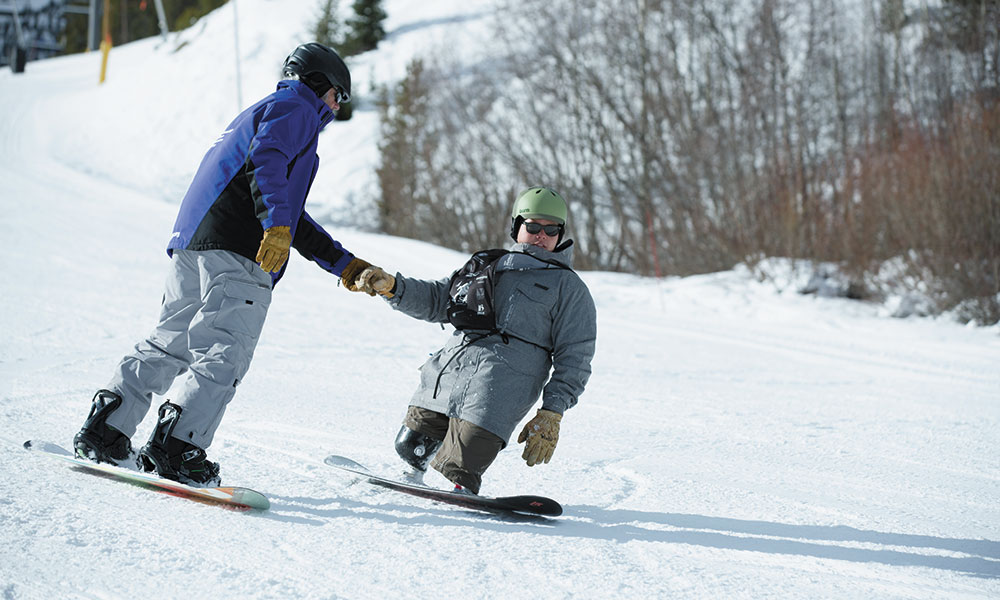
Each year, the publishing arm of the Professional Ski Instructors of America and the American Association of Snowboard Instructors (PSIA-AASI) sells thousands of books and other resources that members use on the road to certification.
But when Mark Dorsey, FASAE, CAE, became executive director almost 10 years ago, he noticed something that troubled him. The organization’s adaptive materials, which guide instructors on how to train people with developmental and physical disabilities, were barely moving. “We weren’t appealing to this market in a way that met their needs,” he says.
After scanning the industry, PSIA-AASI found that most adaptive instructors are volunteers who may not see the value in a full membership.
“Our organization provides members with all of the training materials that you need to get certified as an instructor across a variety of categories. But if you’re a volunteer, you’re probably not going to pay for that,” Dorsey says. “What we realized was that, while volunteers weren’t willing to pay $25 for a book, they would consume the information like crazy if it was made available to them.”
That led to a major shift in organizational thinking. With the help of a grant and other funds raised through its education foundation, PSIA-AASI bought back all of its adaptive training resources and donated them to qualified 501(c)(3) adaptive programs. In essence, it made its training materials free to the adaptive instructor community.
Between June 2012 and April 2014, PSIA-AASI reached 70 organizations in 21 states. Those programs helped almost 11,000 adaptive instructors (10,000 of whom were volunteers) provide instruction to more than 20,000 students.
“To reach the population of instructors who are volunteering their time to teach people with disabilities, we had to get over trying to make them members,” Dorsey says. “We had a culture where we thought, well, these people have to be members in order to get to the goodness of what we have to offer. We turned that on its head by saying, ‘It doesn’t matter. What we’re going to do is we’re going to do well by doing good.’ It’s OK to ask for a donation later, but that’s only going to work if they find value in the program, and that’s what we’re focused on right now.”
In the future, the program, a 2014 Power of A Summit Award recipient, will include an expanded resource library and video materials.
“We were very thorough in tracking the outcomes of the program very directly,” Dorsey says. “Through surveys and comments, we were able to figure out where the gaps in information still exist and what sorts of things were working and not working. We’ll take that feedback and apply it to the next generation of manuals.”

Comments
Comments are for ASAE members. Learn more about comments on this site.
Log in to your member account or join ASAE!