
Background Checks, Backlashes Define Police Conference
The recent meeting of the International Association of Chiefs of Police in Chicago—which featured an appearance from President Obama—highlighted the challenges police officers face on issues such as gun control and the backlash on aggressive tactics.
Heads up: this content is over 5 years old, so some information may be out of date.
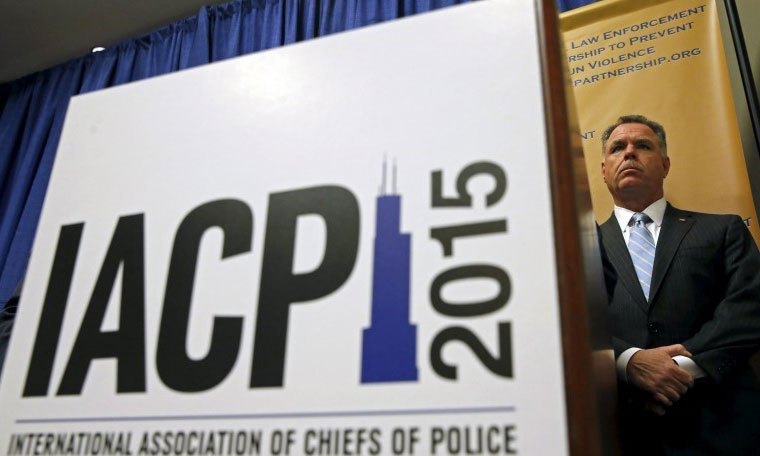
When President Barack Obama made a stop in his home town earlier this week, police chiefs from across the country were waiting for him.
But before the president even had a chance to take the stage at the International Association of Chiefs of Police (IACP) Annual Conference in Chicago on Tuesday, the event was already making big news for a formal stance it had just taken. The chiefs’ group announced it was supporting universal background checks, something President Obama has repeatedly pushed for during his time in office.
Chicago Police Superintendent Garry McCarthy, whose police department welcomed members of the IACP, was among the loudest voices in favor of the move—having seen the gun violence that’s ravaged the city in recent years.
“This is a no-brainer, this is the simplest thing in the world,” McCarthy said, according to Reuters (opens in a new tab). “It troubles me all the time.”
The comments were echoed by the chief of police of Baltimore, another city that’s been in the headlines in recent years. Baltimore police chief Jim Johnson noted that current gun laws require background checks for gun dealers but leave a huge gap elsewhere.
“Background checks do in fact work,” Johnson said on Monday, according to WTTW (opens in a new tab). “They blocked 2.4 million purchases between 1994, when the Brady Law took effect, and 2012. But the Brady Law applies only to dealers. What about those who trade in classifieds or gun shows? These private sales should be an issue we all focus on so we can be a safer society.”
IACP emphasized that it didn’t oppose gun ownership but instead wanted to ensure that guns weren’t falling into the hands of criminals.
A Tough 12 Months
The law enforcement field has been struggling to regain its footing in the wake of a number of serious scandals in cities such as Ferguson, Missouri, and Baltimore. Complaints of racial profiling and the now-pervasive use of video cameras by witnesses have police officers on edge—an issue that, The Economist notes, was a key topic of discussion on the IACP tradeshow floor (opens in a new tab).
In his comments at the IACP conference, Obama attempted to emphasize the differences between the rank-and-file officers on the ground and the structural challenges that create broader societal problems.
“Too often, law enforcement gets scapegoated for the broader failures of our society and criminal justice system,” the president said in his speech (opens in a new tab). “I know that you do your jobs with distinction no matter the challenges you face. That’s part of wearing a badge.”
The president, however, made a distinction in his comments that further discussion was required on the issues raised.
“That doesn’t mean we shouldn’t have a serious and robust debate over fairness in law enforcement and our broader criminal justice system when it comes to communities of color,” he emphasized.
Obama’s comments came on the heels of controversial comments made by FBI Director James Comey, who implied that “the era of viral videos” (opens in a new tab) might be driving violent crime in cities nationwide.
Chicago Police Superintendent Garry McCarthy attends a news conference at the International Association of Chiefs of Police conference. (Jim Young/Reuters)

Comments
Comments are for ASAE members. Learn more about comments on this site.
Log in to your member account or join ASAE!