
Article Marketing / Communications 5 min read
Opposing Forces: When Your Keynoter Has Different Views Than Attendees
What happens when your keynoter has a completely different position than your attendees do? Take some lessons from the Magnet Schools of America’s decision to invite Secretary of Education Betsy DeVos.
Heads up: this content is over 5 years old, so some information may be out of date.
Let me tell you a little bit about Magnet Schools of America (MSA). It’s an association with seven staffers—led by Executive Director Todd Mann, CAE—and its members are magnet school administrators and teachers.
We have an opportunity to just pout for four years and hope for the best, or we have a chance to establish dialogue and hope we can effect some change.
Magnet schools (opens in a new tab) are public schools—usually with a focused theme like arts or science and technology—that receive $100 million in federal funding annually. They emerged in the late 1960s and early 1970s as a way to help desegregate schools and gave parents the option to send their children to schools outside their neighborhoods.
“Magnets were the original schools of choice,” Mann told me earlier this week. He also added that magnet schools have two core principles: racial and socioeconomic diversity.
Every February, MSA hosts a Policy Training Conference in DC where about 150 members take a trip to Capitol Hill to talk to their representatives and hear from policymakers.
From the beginning, the 2017 conference was proving to be timely. Much of that was due to the arrival of a new administration.
“When the Trump administration came into being, and he nominated Betsy DeVos for secretary of education, the positions that DeVos and Trump were taking were completely antithetical to my members,” Mann said.
For example, MSA members were worried about the administration’s interest in school vouchers. “The concern was that public money would be taken out of magnet schools and provided to private schools or religious schools, which is what the Trump administration touted,” he said.
However, Mann also saw this dichotomy between his members and the administration as a potential opportunity.
“Since Trump and DeVos both touted their interest in choice schools,” he said, “and since magnets were part of choice, I saw this as a window for me to say, ‘Rather than you [Trump and DeVos] defining what choice schools mean, I need to get you better acquainted with magnet schools, since they were the original type of choice school.’”
So Mann decided to do something bold: He invited DeVos to keynote the conference.
How He Made It Happen
Mann reached out to DeVos after she was nominated. She initially told him she would not be making any commitments until she was confirmed. “I reaffirmed why this would be a win for her: that magnets are public schools and committed to racial diversity,” he said.
The day after she was confirmed—only five days before MSA’s policy conference would start—Mann got the news: DeVos accepted his invitation and said she was going to use the conference as her inaugural platform.
But then Mann had what he calls “a big gulp moment.” He realized, “If I don’t communicate to other groups in advance about why I’m inviting her, I’ll be the scourge of the entire education field and every civil right groups.”
He reached out to civil rights groups and other education associations and told them how DeVos’ appearance at the conference would give them a chance to speak out for public schools and that it was an opportunity to not pass up.
Mann received two responses. “We agree with you. That’s not a bad first step,” he said. “And the other response: How the hell did you pull it off?”
Part two was communicating to his attendees, who he knew would be upset. “My message to members for inviting DeVos was to say, ‘Before we write someone off for four years, let’s at least see if we can establish a line of communication and get our case made for why magnet schools are important and really make an impact for public education overall.”
At the same time, Mann had to keep the MSA board apprised of the situation. He called an emergency board meeting.
“At first, they were hugely upset,” he said. “But then we started talking, and I said, ‘We have an opportunity to just pout for four years and hope for the best, or we have a chance to establish dialogue and hope we can effect some change. That’s why we have to do this.’”
By the end of the phone meeting, Mann had the board’s backing.
How It Worked Out
The good news for Mann and MSA is that there was little fallout from the event. While a few members told him they understood his reasoning but weren’t happy about MSA giving DeVos a platform, nobody protested by not showing up.
But, when I asked if the experience was stressful, he quickly replied, “Stressful doesn’t even come close.”
MSA got a lot of wins out of DeVos’ keynote. The event was covered in 75 newspapers nationwide and on eight network news channels. And the occasion got magnet schools on the administration’s radar.
“As a small association, I don’t typically have this leverage,” he said. “Lucky for us, this bold move worked, and we’re on her agenda, and we now have follow-up meetings scheduled with her.”
Mann has advice for other associations that might try something similar.
“Make sure you’ve covered your bases in terms of who you are reaching out to, communicating with, and explaining your reasoning to,” he said. “And even if your members feel differently, you can always make a case for keeping the lines of communication and the lines for opportunity open.”
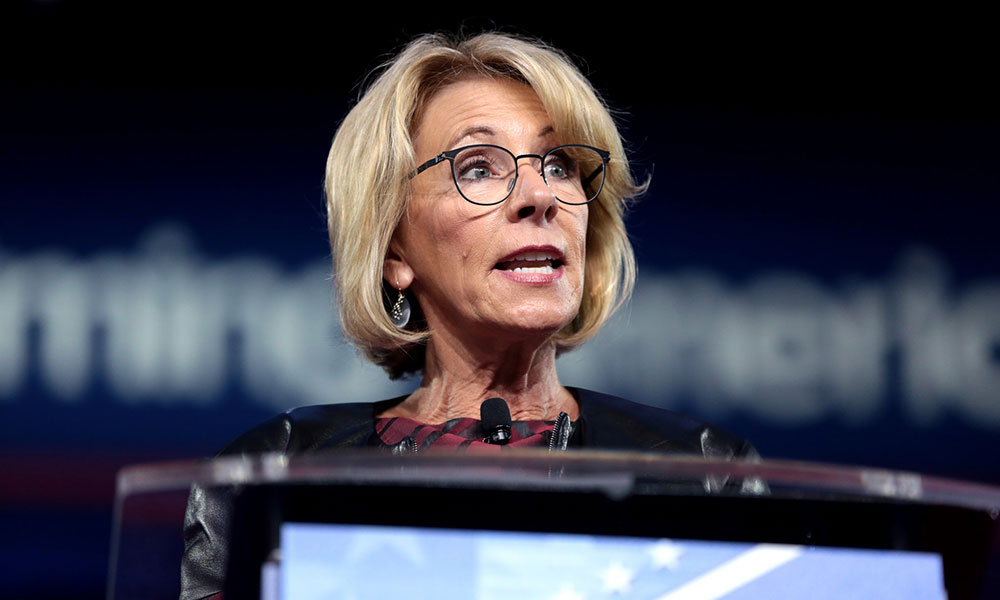
Betsy DeVos recently spoke at Magnet Schools of America’s annual meeting. (Gage Skidmore/Flickr)

Comments
Comments are for ASAE members. Learn more about comments on this site.
Log in to your member account or join ASAE!