
Article Marketing / Communications 3 min read
Is Microsoft Teams More Popular Than Slack? Yes, but …
Microsoft’s chat and collaboration service Teams has been outpacing Slack’s growth since COVID-19 began, but their use cases differ in important ways—particularly in terms of how they integrate with other tools.
Heads up: this content is over 5 years old, so some information may be out of date.
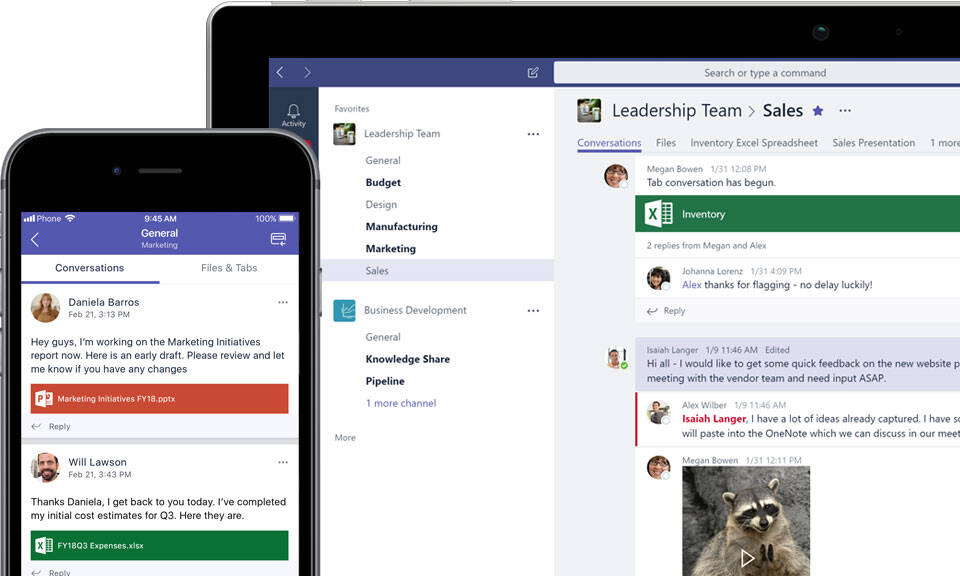
You might imagine that, thanks to COVID-19, the highly integrated Microsoft Teams and its chatroom competitor Slack would be seeing a lot of growth.
But you’d only be half-right on that front. With its deep integration with Office 365, Teams has grown quickly, even outpacing the popular Zoom (opens in a new tab), but Slack recently revealed in an earnings report that its growth was much more modest (opens in a new tab).
To put it simply, one is outpacing the other, and quickly, with Teams beginning to run past Slack last summer—an impressive pace, given that Teams was only announced in March 2017.
“Catching up so quickly in audience size over two years when Slack has been around since August 2013 is a feather in Microsoft’s cap and may be a reason why it has opted to wait so long to announce any numbers about Teams,” Ars Technica’s Anna Washenko (opens in a new tab) wrote last year.
The competition between the two firms has been fierce—with Slack famously taking out a full-page ad in The New York Times (opens in a new tab) in 2016 ahead of the Teams announcement.
In reality, the tools have significant differences that may matter for some organizations. Slack, beyond its basic chat functionality, excels at integration with third-party tools (opens in a new tab), of which there are many due to its more mature developer base.
What makes Slack a great tool is that it doesn’t pigeonhole you into a specific platform. Want to collaborate on a Dropbox file? It lets Dropbox do the heavy lifting, but, importantly, serves as a central nervous system for collaboration.
While Teams also has integrations (opens in a new tab), the strongest integration it supports is with Microsoft’s own Office tools and Azure cloud service, and it excels at more than just chat as a result, representing more of an all-in-one tool. In other words, the tools get directly compared, but they have significant differences under the hood. As The Verge’s Tom Warren put it last year (opens in a new tab):
Microsoft Teams ties closely to Office, Skype, and Microsoft’s cloud services, but the company is far behind the third-party integrations that Slack offers and the overall quality and polish. At the same time, Slack feels a little behind on the video and audio calling front, as Microsoft has deeply integrated Skype and it makes holding meetings and recording them a lot easier.
Stewart Butterfield, the cofounder and CEO of Slack (and in another life, the cofounder of Flickr), has traditionally discounted the competition between the two applications, at times comparing Teams to the faltered Google+. He argued in May that Teams’ success is the result of a not entirely successful bundling campaign.
“So after three years of bundling it, pre-installing it on people’s machines, insisting that administrators turn it on, forcing users from Skype for Business to switch to Teams, they still only have 29 percent which means 71 percent of their users have said no thank you,” he told CNBC earlier this year (opens in a new tab).
And, it should be noted that Slack and Teams aren’t alone in the business chat market. A number of open-source options (opens in a new tab) that integrate many of the same features are out there as well. But both Slack and Teams are evolving quickly, each adding (opens in a new tab) new features by the week (opens in a new tab).
To put it all another way: While Teams may be beating out Slack, the two products (along with their competitors) each take different approaches to driving conversation within an organization. When it comes to the one that works best for your needs, your mileage may vary.
(Microsoft)

Comments
Comments are for ASAE members. Learn more about comments on this site.
Log in to your member account or join ASAE!