
Article Organizational Strategy 4 min read
How The NACM’s Legacy Demonstrates Progress
For more than 125 years, the National Association of Credit Management has been going strong—and it has the archived materials to prove it. The association’s president ponders what has changed about the group in that time, and what has stayed the same.
Heads up: this content is over 2 years old, so some information may be out of date.
This is the last installment of a three-part series on association history. Part 1 looks at the archives of the Association for Computing Machinery; part 2 examines the American Psychological Association’s apology for its contribution to historic systemic racism.
In 1996, the National Association of Credit Management (opens in a new tab) celebrated its 100th anniversary—a milestone notable enough that the website celebrating that mark is still online (opens in a new tab), more than a quarter century later.
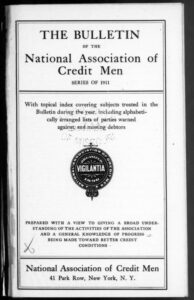
NACM has a long legacy of serving the needs of business-to-business creditors, including under its original name, the National Association of Credit Men. That legacy is reflected in the information it’s made available to budding researchers, including the association’s monthly bulletins—dating to 1902—which can be found on the Internet Archive (opens in a new tab).
“We’re an old organization—sometimes that’s a good thing, sometimes that’s a bad thing,” said the association’s current president, Robin Schauseil, CAE. “But I think one thing that we’re really proud of is that we have a very long and robust history.”
That extends to vintage press coverage, as well. A 1936 Time magazine article (opens in a new tab), highlighting the group’s annual meeting and its use of “pep and song periods” to engage attendees, noted that NACM at the time was the second-largest trade group in the United States.
“Its membership of 20,000 is exceeded only by that of the U.S. Chamber of Commerce,” the article stated. “In unity of spirit, however, NACM has the edge on the Chamber because its members, to a man, are wrapped up in one subject: the payment of bills.”
Some Things Change, Much Stays the Same
An organization with a 126-year history has its own history to live up to as it evolves. But according to Schauseil, the organization’s mission has largely stayed the same, even if its approaches—and its name—have changed with the times.
“I think the entire drive to the organization and for the profession, ever since its inception, is to figure out how to drive pretty good efficiencies, professionalism, and transparency into the whole credit process,” she said. “So I think that as we look back over our longevity, I’m not really sure that the motivations have changed.”
What has shifted? The environment, the technology, and the needs of members. Processes have become more efficient, meaning that credit departments are smaller than they might have been in the pre-computing era.
“Technology has done away with so many manual processes that compelled us to have a larger number of staff,” Schauseil said.
Another change: the name, which swapped out “men” for “management” to become the National Association of Credit Management (opens in a new tab) in 1958, reflecting changes in the profession.
That said, despite decades of evolution and changes in language—Schauseil noted that while terms like ESG (environmental, social, and governance) and GAAP (generally accepted accounting principles) weren’t common in the past—the primary goals of offering and maintaining credit have stayed the same.
“The word ‘credit’ leads to trust. With a credit transaction, you are trusting that you are going to be paid—that hasn’t changed, whether it’s 1896 or 2030. It doesn’t change,” she said.
Also not changing: the bedrock upon which the industry was built.
“The whole reason NACM was formed was to be the guardian of economic stability and ethical, sound business practices. And that really hasn’t moved,” she said.
The Legacy Today’s NACM Could Leave
Given NACM’s long history and the fact that its centennial site has passed the test of time, it’s natural to assume that the organization has a strong future. What could the association’s bicentennial site look like?

Schauseil suggested it could reflect the credit industry’s emergence from the back room.
“I think the profession has evolved from ‘Let’s keep credit professionals in the basement, wearing green eyeshade, working by candlelight,’ to recognizing that credit is a huge corporate partner,” she said. “Whether it comes to vetting supply chain partners, whether it comes to vetting merger partners, whether it comes to actually making the decision to extend or not extend credit to customers.” In fact, the very existence of NACM archives demonstrates one of the tenets of the credit profession: transparency, a principle getting more attention than ever now.
While Schauseil acknowledges that she will likely not be around to see NACM’s bicentennial in 74 years, it would bring her joy to know that the credit industry emerged into a more central role within a given organization.
“What would make me smile would be to know that credit professionals are considered to be among C-suite players because of the important role they play in their company,” she said.
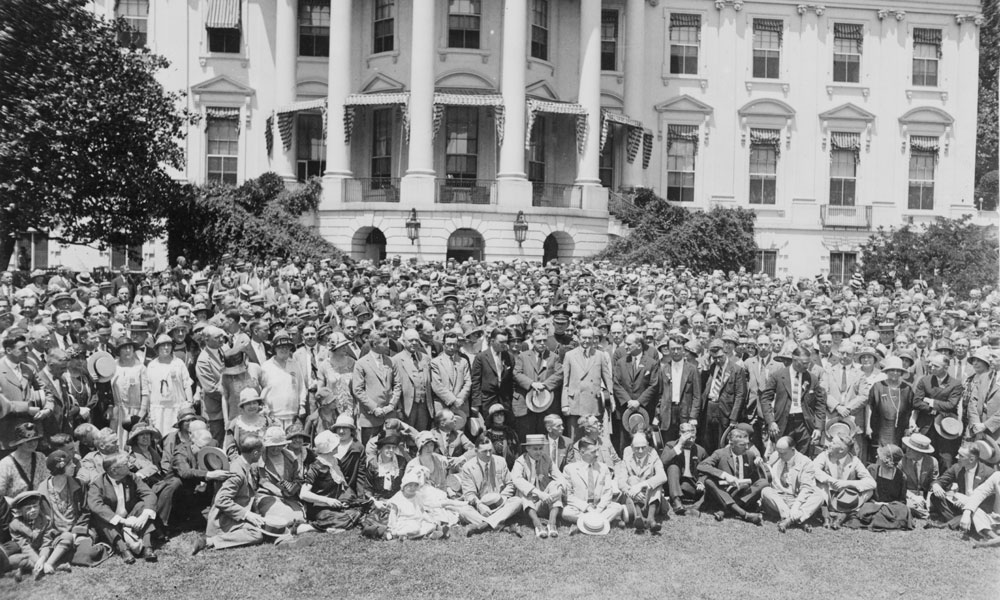
Members of the National Association of Credit Men pose with president Calvin Coolidge in front of the White House in 1925. (Wikimedia Commons)

Comments
Comments are for ASAE members. Learn more about comments on this site.
Log in to your member account or join ASAE!