
Article Organizational Strategy 4 min read
5 Tips for Analyzing Your Association’s Financial Statements

Heads up: this content is over 2 years old, so some information may be out of date.

Association financial statements provide the insights necessary to make various informed decisions. From revenue forecasting to risk mitigation, these statements are vital for healthy financial management (opens in a new tab).
However, to extract actionable insights, your association’s leaders must know what to look for in financial statements. This guide explores five tips for analyzing your association’s financial statements to help you make better financial decisions.
1. Evaluate key ratios
Calculate key financial ratios to access a quick summary of your organization’s financial performance. While the relevant ratios to track may vary across industries, most associations should evaluate:
-
Liquidity, which measures your association’s ability to meet its short-term obligations.
- Current liquidity ratio: Divide current assets by current liabilities. Typically, a range between 1.5 and 3 is considered healthy, as this indicates your association has more current assets than current liabilities.
- Quick liquidity ratio: Subtract any inventory from your current assets, then divide the result by your current liabilities. This formula excludes inventory, meaning in-kind donations accepted (opens in a new tab) or other assets not easily convertible into cash won’t be represented in this ratio. A ratio of 1 or more indicates your organization can meet its short-term obligations without selling inventory.
- Solvency, or your association’s long-term financial stability and ability to sustain operations.
- Debt-to-net assets ratio: To measure this ratio, divide total liabilities by total unrestricted net assets. A ratio under 2 suggests that your association has a solid foundation of net assets that aren’t limited by donor restrictions. A higher ratio may indicate your organization is overly reliant on borrowed money.
After calculating these ratios, identify any deviations from the recommended ranges and construct a plan to correct your association’s financial performance.
2. Identify long-term trends
Compare your financial statements year-over-year for more context into your association’s evolving financial situation. Identify notable trends or patterns in your organization’s financial history to draw conclusions about any recurring issues or strengths.
Key areas to monitor include:
- Revenue streams and growth
- Expense trends and cost management
- Asset growth, including tangible resources, like property, and monetary resources such as investments
Depending on the trends revealed in your past financial statements and budgets, you’ll gain the foresight (opens in a new tab) needed to improve your management practices for the future.
3. Address budget variances
Identify variances in your association’s budget by comparing budgeted figures against the actual results reflected in your financial statements. Address any differences between the planned and realized expenses by:
- Preparing for unexpected costs: Unanticipated expenses, such as repairs to your facility, are inevitable yet costly. If your organization consistently incurs such costs, revisit your operating reserves (opens in a new tab) to ensure you maintain a healthy amount of emergency funding.
- Preventing revenue shortfalls: Inaccurate budget projections can cause your organization to plan its spending and association fundraising (opens in a new tab) needs inadequately. To prevent this, forecast revenue conservatively and diversify your revenue streams to help you recover if one source falls through.
- Mitigating cost overruns: When the cost of a project exceeds the budgeted amount, your association must scramble to finish the project without depleting its resources. Lessen this blow by regularly reviewing the project expenses to identify scope changes early. This way, your association can proactively account for any additional funding needed.
Look for relevant patterns in these variances and adjust your budget accordingly. For example, if your association consistently designates too many funds to a specific program, consider allocating the leftover amount to a different project in future budgets.
4. Focus on cash flows
Chazin and Company defines the statement of cash flows (opens in a new tab) as a report of the inflow and outflow of money within an organization that is “valuable for evaluating the impact of strategic decisions on cash flow.” Typically, these statements are broken down into three categories, as the following template shows:
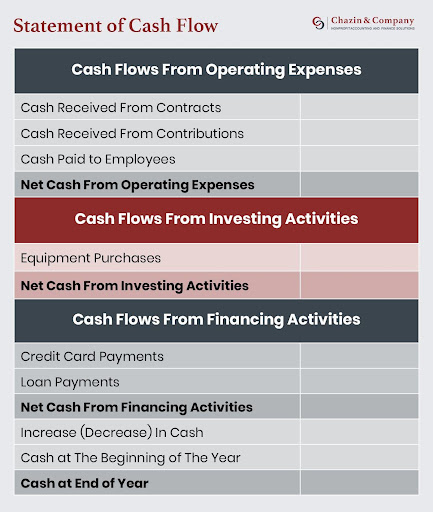
- Operating activities
- Investing activities
- Financing activities
Understanding where your association’s money comes from and goes significantly impacts your financial health. Consider how your organization’s various cash flows can support the organization’s strategic decisions.
5. Establish frequent reviews
Continuous monitoring of your association’s financial statements is crucial to detect financial discrepancies early, identify trends, and ultimately master the budgeting process. Schedule regular reviews to standardize your financial analysis. Ideally, reviews should take place monthly.
Remember to involve your financial committee in the review process to ensure transparency and build trust. Additionally, your board can benefit from the diverse perspectives that may be offered by financial experts on your team.

Comments
Comments are for ASAE members. Learn more about comments on this site.
Log in to your member account or join ASAE!