
Article Meetings / Events 7 min read
The Tech Effect for Meeting Planners and Attendees
With smartphones, tablets, and apps changing the face of modern life, it’s only natural that these technologies would change meetings too—for planners and attendees.

Heads up: this content is over 5 years old, so some information may be out of date.
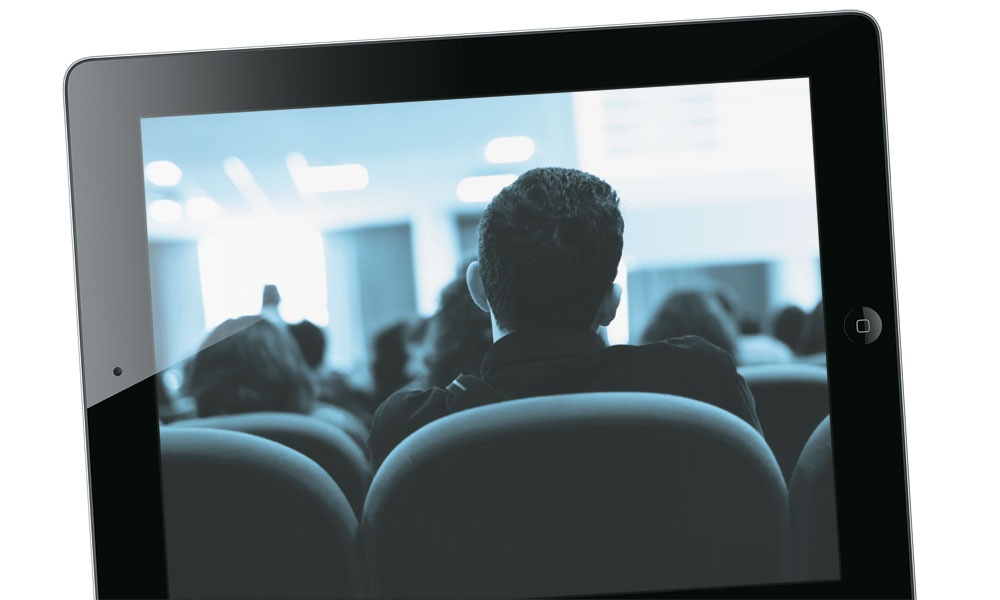
IN 2005, the American Speech-Language-Hearing Association did the unthinkable. It gave away seats to its October meeting just to make the rooms look full.
“We were having a challenging time with [one of our smaller] in-person conferences,” says Jack Coursen, associate director of professional development at ASHA. “But we knew [attendees] were very tech-savvy.”
So the following year, the organization held its first virtual conference and, just like that, doubled its registration. The conference was a near-replica of its in-person predecessor, a total of 15 hours over three days. Because it was the pilot year, the registration fee was heavily discounted, to $80. The next year, the registration fee was back on par with the standard in-person conference fee ($329), and the virtual conference was expanded to 11 days and dozens of hours of content. The upshot: ASHA doubled its registration numbers once again and brought in more than $50,000 in net revenue.
“It’s so much more convenient and flexible,” Coursen says. “Think about everything that could potentially go wrong at a conference—detractors like a bad hotel, bad food, expensive flight, too much time off work—and you eliminate it.”
In recent years, technology has brought extraordinary changes to meetings, conferences, and tradeshows. From event-planning software to post-event surveys, devices and their programs have revolutionized the way meetings are planned, organized, and attended. But there’s more to it than just throwing the newest and shiniest hardware around the convention center.
“Technology at an event is successful when it’s interactive,” says Ann Windham, president and CEO of Imagine Xhibits, Inc. “It’s not the technology itself. So if the technology is creating an experience that’s memorable—faster access, shorter lines—then it’s doing its job and people remember it. It’s got to be more than just the cool factor.”
Left to Devices
The big issue with technology, says Francis Friedman, president of Time & Place Strategies, is understanding what audiences want and then figuring out how to give it to them. “We’ve become a digital and device society,” he says. “But the organizer has to program his or her show so it’s uniquely different from anything out there. It’s about answering the question, ‘Why should I attend your event?’”
“If the technology is creating an experience that’s memorable—faster access, shorter lines—then it’s doing its job. It’s got to be more than just the cool factor.” —Ann Windham
Like ASHA, countless associations have already found success by capitalizing on technology trends. “We have to think smarter,” Windham says, “and there are a couple basic tools that any meeting planner can’t live without.”
The first is the iPad, which can be used for site previews, show management, badge-scanning, and even as an uber-remote control. “Anything that can be turned off and on can be done with an iPad,” Windham says. “Say you want to time a fountain to come on at a certain time, or someone is giving a toast and their mic isn’t loud enough. I don’t have the staff that I had five years ago, but now I can just stand in the back of the room and touch a button on the iPad.”
Windham says the cloud is key to using this new technology effectively. She might be managing concurrent events in Las Vegas and New Orleans, and carrying around two giant binders isn’t an option. Through the cloud, she can revise registration lists, flight schedules, and room blocks, allowing colleagues in other cities to see and review her changes and updates. Another plus: “I can buy the cheapest iPad—with the smallest amount of memory—and then store everything in the cloud.”
At the Professional Beauty Association, the meetings team began using iPads for onsite show management in 2012. Associate Executive Director of Business Development Eric Horn says he can’t imagine ever returning to paper. “We replaced a three-ring binder that was probably 145 pages,” he says. “We used to walk around with that and mail one to every exhibitor.”
There is a bit of a learning curve with the switch to tablet, of course. Accessing files on a tablet is not as easy as flipping to a “shipping” tab in your binder. “The last thing you want when you’re with a client is to spend 20 minutes looking to find something,” Horn says.
Given all the ways tablets can work during a conference, imagine what it can do in a year. That was the thinking at the Cardiovascular Research Foundation, which will give a tablet to each of the 10,000 full-paying attendees of its Transcatheter Cardiovascular Therapeutics symposium (cosponsored with the American College of Cardiology) in October.
“By giving attendees the hardware, we will start our digital platform at the meeting, but it will continue long after that,” says Johnnie White, executive director of the CRF Center for Education. “We’ll continue feeding content to the app. It will have content for all meetings throughout the year.”
Data Capture
Attendees often get copies of PowerPoint presentations as handouts during or after a meeting. But imagine putting a presentation in their hands as it’s happening—via smartphone. Friedman says this is one of the coolest uses of technology he has seen recently.
“While they are watching the presentation on stage, they can capture it on their device, send it to a friend, tweet it, send the speaker a comment, and send questions up to the stage in real time, which enhances the conversation,” he says. “Not to mention, those in the back of the room who can’t see the screen will actually be able to read it.”
“If you can engage people on mobile, they will give you data, and then you can provide more data to your exhibitors.” —Lawrence Coburn
In a recent article in VentureBeat, Lawrence Coburn, the CEO of event app developer DoubleDutch, noted that $108 billion is spent every year on event production in the United States. “Personally,” he writes, “I think spending such a huge amount of money without a clear understanding of ROI is reckless.”
His response: DoubleDutch’s lead-scanning technology and customized apps. Until recently, he says, expos and meetings have been an offline experience, but now, it’s easy to capture information as a digital record of attendees’ activities.
Unlike a scanner, which provides value only if somebody visits a booth, mobile technology can generate leads among those who never hit the expo floor. “Say there is an executive who is too busy” to stop by the exhibit hall, Coburn says. “But he is checking out an exhibitor app and, therefore, leaving a digital trail. That’s a signal. If you bookmark a page or go hear a speaker, those are signals. Our approach is to try to build an engaging mobile app. It can’t just be a digital version of the paper guide; it has to be more like LinkedIn. The more it is used, the more data is generated.”
And that’s a good thing for your expo, as exhibitors are constantly seeking greater value from your events. “If you can engage people on mobile, they will give you data, and then you can provide more data to your exhibitors,” says Coburn.
Another growing trend is near field communication, or NFC. It’s a form of wireless communication embedded in some smartphones, similar to RFID (radio frequency identification) but used for very short-range communication—such as between two devices or a device and an NFC-enabled tag. ITN International creates NFC badges, called BARDs, which are preloaded with data like an attendee’s contact information, social networks, session selections, and special event access. The microchip can do everything from track attendance to manage meal payments. In January, the Consumer Electronics Association will roll out NFC-tech-enabled badges.
In the future, Windham says, trends will include technology that is part of us—from Google Glass to projection mapping, which can project 3D glaciers 360 degrees around a room to make a visitor feel like he or she is in Alaska. At the same time, technology will continue to get smaller—desktop computers will become obsolete, and we might one day be communicating through wristwatches.
So with all this technology, what is the best way to stand out from the crowd? “Here’s an inside secret for people selling booth space,” Friedman says, proving once and for all that some etiquette is timeless: “I recommend my clients use the U.S. Mail and send a handwritten card.”
(Getty RF)

Comments
Comments are for ASAE members. Learn more about comments on this site.
Log in to your member account or join ASAE!