
Article Operations 4 min read
Open-Plan Offices: Are You Open Enough?
When looking for a new office space in downtown DC, the National Retail Federation decided to change not only its physical location but also its office setup. Find out how and why the association chose an open-plan office.
Heads up: this content is over 5 years old, so some information may be out of date.
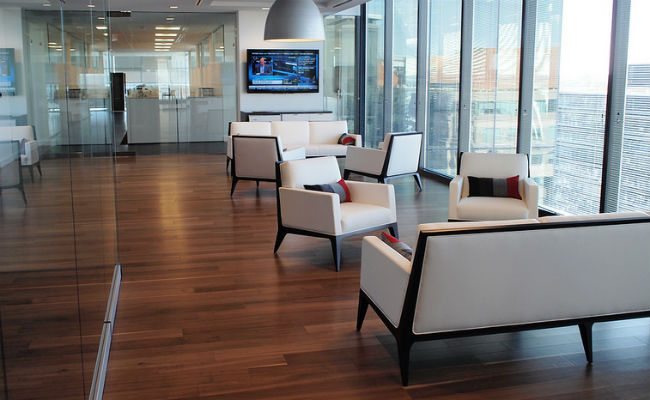
While the jury is still out on the best type of office set-up—open, cubicles, virtual, or other—the allure of increased collaboration and idea sharing are convincing some organizations to tear down their walls in favor of a more open, airy work space—despite any potential drawbacks (opens in a new tab) or complaints.
This was the case for the National Retail Federation, which recently moved into a new open-plan office space in Washington, DC. Given the buzz on open offices, we wanted to find out more on why the organization chose this type of setup and how the new space is working out so far.
Below, Carleen Kohut, NRF chief operating officer and chief financial officer, shares some insight into the organization’s decision to go open:
When thinking about the kinds of spaces to move to, why did NRF decide on an open plan?
We really started evaluating how we wanted to work.
We host a ton of coalitions. Advocacy is one of our key pillars, and we had one of the largest conference rooms in town … and, yet, we still could have used more. So, we met with our board, and their guidance to us was [to] look at your space as a tool that helps you accomplish your mission.
We approached it from an advocacy side—building a multi-purpose, flexible space so we can do receptions, coalitions, fundraisers, et cetera—as well as looking at how the team itself works and how we can foster more collaboration and creativity.
Our CEO, Matt Shay, his favorite phrase is “creative collision”—that thing that happens when two people run into each other just walking down a hallway.
Did you get any feedback from staff before moving?
We polled the staff, our stakeholders, and our board members, and one thing we heard really clear from the staff was that we needed more room and spaces where we could meet.
So, now we have nine team rooms of various sizes. We have five smaller rooms—call them quiet rooms—where people can go to make a phone call. We also have a huge boardroom with demountable glass and tables that we can take apart. We have a very nice executive conference room. We also built the coolest café.
We wanted a different kind of space where staff could work and meet.
NRF’s new café.
Can you describe what the individual work stations are like?
Some of them are singles. They’re 42 inches tall with a 9-inch glass panel on top of it so you have these sightlines all the way across the space.
In the double work stations, we put small little tables where people could gather, again kind of following the notion of work any place, anytime and have that creative collision thing if you want.
Each workstation has built-in storage, and on top of it we built cushion tops so people could drop in and visit and have a place to sit.
Everybody has seated privacy. If you’re seated at your desk and you’re looking at your monitor, you have privacy, but if you stand up, you can see what’s going on. And that was a very conscious decision.
Did you consider potential cons, like loss of productivity due to noise?
I can’t tell you the HOURS we spent going over that, and we are still certainly learning.
A couple of things that we did: One is white noise. I have had so many people comment to me about how effective it is. It’s very subtle but effective.
We’re all also practicing our inside voices. Matt and I brought this issue up at so many staff meetings [before we moved]. We said: “We understand this is a change in how we work, this is a change in our culture. Hopefully, it will encourage creativity.”
We had conversations with staff in which we said, “It’s OK to say to someone ‘I’m tied up right now, can you come back?’”
We knew this was a change and we were all going to have to learn how to work in the open space—so far, so good.
One of the single work stations at NRF.
If you had to pick one, what’s the biggest advantage to going open?
The energy. By moving, it gave us a chance to look at our adjacencies and where departments were located.
In our old space we kept expanding and expanding and putting people in whatever place we could find. Now [in the new space] we’ve tried to lay people out where we’re leveraging things. So, the foundation, communities, and marketing, they kind of wrap a corner with PR and there’s a ton of interaction among them.
The way we’re laid out, we’re able to leverage everyone’s skills for the greater good—open and transparent. “Oh, you’re working on that? I’m working on that, too.”
Has your association considered going to an open-plan office space? Or maybe you’re already in this type of space—let us know your thoughts on open offices in the comments.
The front desk/welcome area in the National Retail Federation’s new DC headquarters.

Comments
Comments are for ASAE members. Learn more about comments on this site.
Log in to your member account or join ASAE!