
#ASAE18: Value Means More Than Money, Says Kickstarter Founder
Former Kickstarter CEO Yancey Strickler’s startup made crowdfunding work and helped turn thousands of ideas into reality. Along they way he held firm to a philosophy that defines value more broadly than profit. Kicking off #ASAE18, he urged association professionals to do the same.
Heads up: this content is over 5 years old, so some information may be out of date.
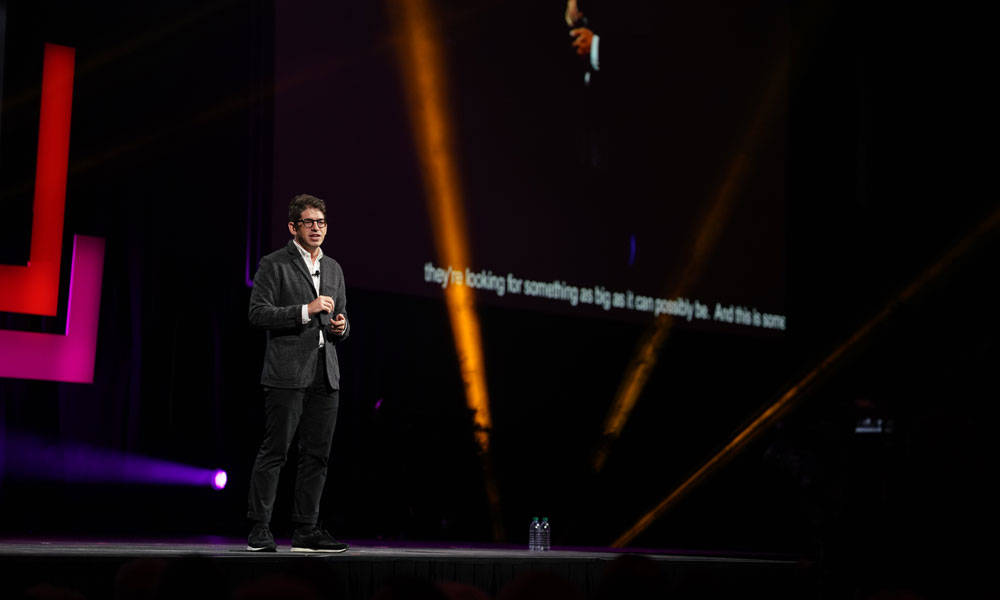
If you’re rethinking how your organization operates, says Kickstarter cofounder and former CEO Yancey Strickler, rethink how you define “value.”
In Sunday’s Opening Keynote at the ASAE Annual Meeting & Exposition (opens in a new tab) in Chicago, Strickler challenged attendees to look at matters beyond profit and expansion when they think about what’s most beneficial for their organizations, their members, and society at large. Ideas such as community, future orientation, knowledge, purpose, security, and tradition can be just as valuable and transformative—and more ethical than what he calls a fixation on “financial maximization.”
Associating and gathering based on nonfinancial interests is going to be crucial for the future. You all are on the right side of this.
“To say that financial value is the only thing we can think about is a very limited way of thinking,” he said.
Strickler framed his argument around his own experience at Kickstarter, which he helped launch in 2009 as a crowdsourcing platform for artists looking for outside funding for their projects through individual pledges. Kickstarter enjoyed rapid success: Since its launch, it has funded 150,000 projects through nearly $4 billion from more than 15 million backers, and by 2012, one million-dollar project was fully funded every week. But, at each pivotal moment during the company’s rise, Strickler encouraged the organization to take a step back and consider whether it was pursuing growth for its own sake.
For instance, in 2012 it published a blog post titled “Kickstarter Is Not a Store (opens in a new tab),” which reasserted that the purpose of the site was to help incubate unfinished and unusual projects, not to sell polished ones. It required creators to talk about the risks and challenges of their ideas when soliciting pledges and prohibited simulations and product renderings that gave a false sense that their work was ready to market.
That post received plenty of pushback from creators who’d begun to see Kickstarter as a place to promote themselves in ever-flashier ways. “We got a lot of comments, most of them saying, ‘F you,’” he said. “But we decided to pump the brakes. We said, ‘This isn’t leading to a healthy place.’”
Kickstarter expanded on that idea in 2015, when it became a public benefit corporation, which is “legally obligated to consider the impact of their decisions on society, not just shareholders,” as the company’s statement explains. As a PBC, Kickstarter has banned the use of forced-arbitration clauses with users and refused to take advantage of tax loopholes.
“We asked, ‘What seems like the ultimate right thing to do?’” he said. “How can we set a positive example?”
Strickler said much of his concern about redefining value stems from his experience living in New York City. Since moving there in 2000, when he started a career as a successful music critic, he saw many of his favorite clubs, shops, and other small businesses forced out to clear the way for bank branches and fast-food restaurants, to the point where 37 percent of businesses in Manhattan are now chain stores. That change, he said, reflects how pursuit of profit has flatlined wages and “blocked a generation of entrepreneurs from pursuing their dreams.”
Strickler said he recognizes that changing people’s default settings to think about value in ways that go beyond profit is a steep challenge, but not an insurmountable one. Consider the three-point shot in basketball, he said. When it was introduced in the NBA, coaches and teams avoided taking advantage of it, thinking it too difficult or risky. But as more data revealed that the three-pointer is often the smartest move on the court, more teams have taken advantage of it, to the point where the three-pointer is a critical element of game strategy.
But those transformations in thinking about value are only successful if people are vocal and articulate about how they’re doing the redefining, and he suggested that associations are well-equipped to play that role.
“Associating and gathering based on nonfinancial interests is going to be crucial for the future,” he said. “You all are on the right side of this.”
Strickler encouraged attendees to ask themselves three questions to begin the change process: Why do you exist? What’s different about you? What’s success for you? The answers may be outside of the mainstream, but Strickler recommended embracing them anyway.
“You may be an odd duck, but the odd duck is the only interesting one,” he said.
And beyond just addressing those questions, Strickler emphasized the importance of sharing experience with the community at large, in the same way Kickstarter encourages creators to share the challenges and risks inherent to their individual projects. “A commitment to a different set of values, and the courage to share them, can make amazing things happen,” he said.
(Jason Keen)

Comments
Comments are for ASAE members. Learn more about comments on this site.
Log in to your member account or join ASAE!