
Article Executive Leadership 5 min read
Association Executive Compensation: What’s Your Worth?
A look inside trends in association executive compensation, including how trade group heads, women and CEOs are doing these days.
Heads up: this content is over 5 years old, so some information may be out of date.

How much is that association executive in the window? About $169,309.
That’s the median salary for association CEOs reported in ASAE’s 2012–2013 Association Compensation & Benefits Study (opens in a new tab). Of course, CEO pay is as varied as associations themselves. Executive salaries depend on myriad factors, such as location, staff size and budget, industry served, and membership structure, not to mention the CEO’s duties and professional experience.
But taking a big-picture view reveals some interesting patterns, three of which we’ll explore here. To gain some perspective, Associations Now spoke with three professionals in the association industry: Christie Tarantino, FASAE, CAE, president and CEO of the Association Forum of Chicagoland; Bob Waller, CAE, president and CEO of Association Headquarters, an association management company; and Shira Harrington, executive recruiter and career consultant with Purposeful Hire, Inc.
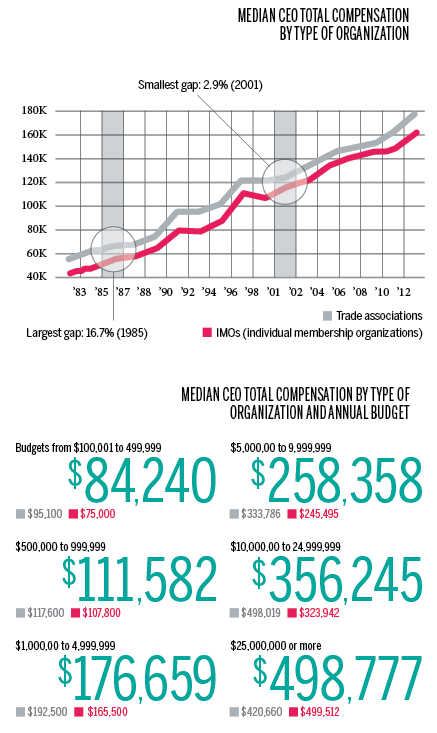
Get Paid at a Trade
In a nutshell: Executives of trade associations typically earn more than their peers at individual membership organizations (IMOs). This gap, while not massive, has existed for as long as ASAE has measured association executive compensation, both across all associations and within most budget ranges.
Why: In short, board makeup and advocacy priorities. Trade association boards are largely composed of executives from member companies, who are both more comfortable paying high salaries to their association executives and more motivated to pay a premium for lobbying power.
“At an individual professional society, you may have the membership base themselves in a salary band that is much lower than what they’re going to need to pay the CEO of their professional society, and I know that comes into play at times,” says Tarantino. “If you’re running a large association but your members’ average pay is significantly less than yours, then you do have a bit of a challenge in negotiating your own salary.”
And while IMOs certainly engage in advocacy, Harrington says the link between legislative affairs and a trade association member’s bottom line is more direct, leading to a greater emphasis within the trade sector on a CEO’s influence in the halls of government.
“Lobbyists tend to be paid a premium for their ability to put food on the table of the businesses that they’re representing, whether they’re in a lobbying firm or an association,” she says. “If they eventually make their way up the food chain to the head of a trade group, they’re carrying that high salary threshold with them.”
More women than not will negotiate very little, whereas a man in the same circumstance will typically negotiate for every penny and will push for more.
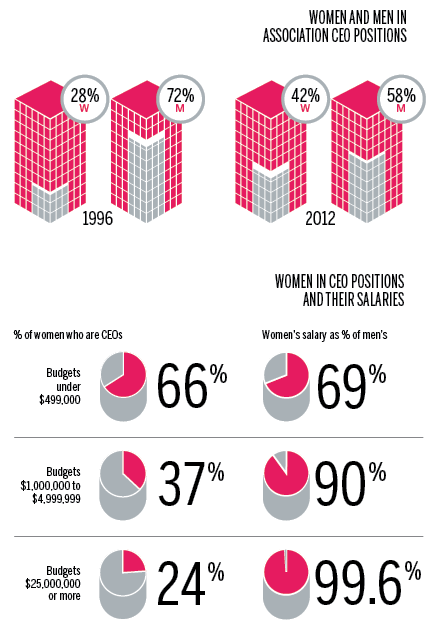
The Gender Gap
In a nutshell: Overall, women are closing the gap with men in the number of CEO positions held, but the difference in salaries remains large, particularly in smaller associations, despite women holding the majority of top executive jobs in those organizations.
Why: A generation of women have been working their way into executive positions in associations, and the data show a steady—though perhaps slower than some would like—march toward equality in the number of women and men CEOs.
“The number of women serving in senior staff roles—it doesn’t surprise me to see that it’s increasing, and I think it will continue to do so,” says Waller, whose AMC staff employs 24 chief staff executives, 20 of whom are women.
Earning top jobs is only half the battle, and Harrington says women must be more assertive in negotiating for better pay.
“More women than not will negotiate very little, whereas a man in the same circumstance will typically negotiate for every penny and will push for more. I have seen that as a recruiter year after year after year,” she says.
Though women occupy a smaller portion of CEO positions at the associations with the largest annual budgets, the ones who do are earning as much as their male counterparts.
“When you get into these larger organizations, they’re using search firms, so there’s probably more structure around what this job should pay,” says Tarantino, “whereas when you look at [annual budgets] under a half a million, under a million, they may or may not be using a search firm to conduct that search, and that may influence how the pay is structured, too, not having that perspective.”
Or, as Harrington put it, women who make it to the very top don’t get there by chance: “If you can’t negotiate your salary, it will be a harder climb to head a $25 million trade association.”
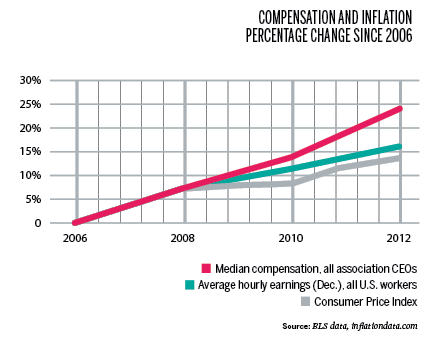
What Recession?
In a nutshell: Despite a deep recession and slow economic recovery, association CEO compensation has increased healthily since 2006, notably faster than inflation and the typical American worker’s pay.
Why: Association boards demand a lot of their executives, and it appears they will pay for results. Waller, Harrington, and Tarantino all say the recession has affected what is asked of association CEOs in a way that entails higher risk but higher reward.
“Since the start of the recession, revenues have become a huge factor in how association CEOs are evaluated—their ability to bring in and maintain revenue,” says Harrington.
Waller says he sees more emphasis on staff execution and leadership than in the past.
“As volunteers are getting crunched with time, the staff has had to step in and take on work and responsibilities that for some organizations had previously been held by the volunteers,” he says. “So, I think the volunteers are willing to compensate the chief executive in response for those additional responsibilities.”
The recession has also forced associations to face a lot of change and uncertainty, and CEOs are charged with navigating it.
“Now that we’re coming out of the recession, boards are saying, ‘OK, we survived it, or we grew, or if we didn’t, how are we going to position this organization to be successful in this new economy?’ So, they’re looking for people who have had some change management experience,” says Tarantino.
In practical terms, the nature of CEO employment also weighs in favor of increasing salaries. Two-thirds of association CEOs sign a formal employment contract, typically three years in length. “For them to have even gotten to that place to begin with, they’re probably pretty good negotiators, usually with the support of an attorney,” Harrington says.
(Siephoto/Masterfile)

Comments
Comments are for ASAE members. Learn more about comments on this site.
Log in to your member account or join ASAE!