

 Sponsored By Aplusify
High-Tech, High-Touch: Why the Future of Association Advocacy Requires Intelligent AI Agents
When AI is implemented as a strategic partner, leaders can focus on the pillars of their core mission—advocacy, community, and human connections no algorithm can replicate.
The modern association stands at a pivotal point of opportunity. For decades, the mission-driven work of these organizations has been powered by a passionate commitment to advocacy and community. Today, that commitment is being amplified by a new era of technology that empowers associations to scale their impact while deepening their personal connection to every member.
Rather than viewing digital tools as simple administrative aids, forward-thinking association leaders are recognizing a new operational standard. We have moved beyond the age of mere data storage and into the age of intelligent orchestration. The goal is no longer to just manage a database; it is to cultivate a proactive, relationship-first association, where technology handles the mechanics so human talent can focus on the mission.
As member expectations evolve, providing a personal touch is no longer a luxury—it is a strategic requirement. For association leaders, meeting this expectation of adding a personal touch to their operations while using AI agents requires a shift toward a high-tech, high-touch framework that prioritizes responsiveness and relevance.
From Automation to Intelligence: The New Digital Partner
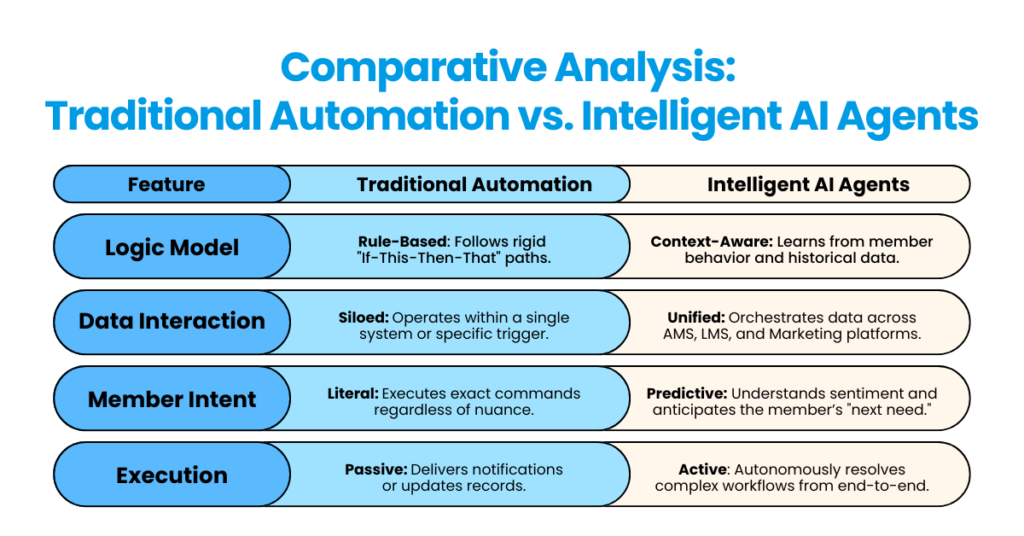
To navigate this transition, it is helpful to distinguish between “automation” and “intelligent agents.” Traditional automation follows preset rules—useful for sending a scheduled email, but limited in its adaptability. In contrast, intelligent AI agents are context-aware. They serve as an execution engine that sits on top of your existing systems to create a unified member view.
“AI is rapidly becoming a practical tool for associations to improve operational efficiency and member engagement,” said Chassidy Hall, director of enterprise applications at the American Psychiatric Association. “By automating routine workflows and leveraging data for smarter decision making, organizations can reclaim significant staff time and redirect it toward strategic, high-touch member interactions.”
This transition isn’t about working harder; it’s about expanding the horizon of what a team can achieve. “Importantly, AI is not just about doing the same work faster,” Hall continued.
“It is amplifying the capabilities of already efficient teams, enabling them to take on more complex, higher-impact initiatives.”
The Architecture of Trust: Ensuring Data Integrity for AI
The effectiveness of any AI agent is tethered to the quality of the data it processes. For associations, this underscores the necessity of moving away from fragmented systems toward a unified data architecture. When member information is siloed across separate platforms, an AI agent cannot provide the context-aware service that modern members demand.
Building this “architecture of trust” means prioritizing data hygiene and system integration. Recent performance benchmarks indicate that associations prioritizing data unification see a significant improvement in data accuracy. This precision is what allows an AI agent to accurately suggest a certification path or a relevant legislative brief. Without a unified member view, AI is merely a faster way to deliver generic content. With it, AI becomes a precision tool for personalized advocacy.
Personalization as the New Standard for Engagement
In the past, providing a deeply personalized experience for every member was a logistical challenge. Today, it is a prerequisite for growth. Deloitte’s “2026 Global Human Capital Trends” report emphasizes that organizations that successfully integrate AI to augment human capabilities are nearly twice as likely to achieve their desired outcomes.

For an association, this looks like:
- Always-on support: Members receive instant assistance at any hour.
- Proactive lifecycle management: AI agents identify subtle shifts in engagement and prompt a personalized outreach mission.
- Frictionless onboarding: New members receive a curated experience that aligns immediately with their goals.
Scaling Mission Without Inflating Overhead
One of the most significant advantages of intelligent agents is the ability to scale member services without a corresponding increase in administrative headcount. In a traditional model, as membership grows, so does the volume of support tickets and renewal inquiries. Eventually, organizations face the choice of either increasing staff costs or allowing the quality of member service to decline.
This shift supports a move from reactive service delivery to proactive, personalized engagement, which Hall notes is “increasingly essential as member expectations evolve.” She adds that industry research continues to highlight AI’s role in enhancing decision making, “reinforcing its value as both an efficiency driver and a catalyst for deeper member impact.”
Strategic Agility: Moving From Reactive Service to Proactive Engagement
The historical hallmark of association service has often been the “helpful response”—a reactive posture that waits for a member to encounter a hurdle. True strategic agility requires a shift toward a proactive engagement model, where the organization uses intelligent insights to meet members where they are.
However, as associations adopt these tools, they must align with the specific comfort levels of their members. Recent data from the Salesforce “State of the AI Connected Customer” report reveals that nearly half of business buyers (46 percent) would work with an AI agent for faster service, and 38 percent are comfortable with agents creating personalized content. Conversely, only 17 percent are comfortable with an agent making financial decisions for them.
This nuance is critical: Associations should leverage AI for what members want most—speed and personalization—while keeping human experts in the loop for complex or sensitive advisory roles. Hall notes that this transition supports a move toward proactive engagement, which is “increasingly essential as member expectations evolve.”
The New ROI: Measuring Success Through Member Impact and Mission Growth
As associations integrate intelligent agents into their core operations, the traditional metrics of digital transformation must also evolve. Success is no longer measured simply by a successful system go-live or the reduction of a backlog. Instead, the “new ROI” is found in the expansion of an association’s mission and the depth of its member impact. When technical friction is removed, the true return on investment is the reclaimed capacity of the staff to innovate, lead, and advocate.
Focusing on these higher-level outcomes allows leadership to measure what truly matters: an increase in grassroots advocacy participation, higher satisfaction scores in professional development programs, and a measurable rise in member retention. By shifting the perspective of success from technical efficiency to mission-driven growth, associations can ensure that their technology investment is not just a line item in the budget but a foundational catalyst for long-term sustainability and influence in their respective industries.
Empowering Advocacy Through Strategic Orchestration
The real power of AI agents lies in their ability to bring structure to a fragmented operational landscape. This allows leaders to reallocate their most valuable asset—their people—toward the “soul” of the business: empathy, advocacy, and community building.
“The goal of implementing intelligent AI agents is not to replace the human element, but to empower them,” said Neeraj Garg, global COO of Aplusify.
“By delegating the technical friction of membership management to intelligent systems, we allow association leaders to lead with vision rather than administration.”
Garg emphasizes that this orchestration is the key to true digital transformation. “When you unify your data and automate the mundane, you aren’t just improving your technology; you are increasing your organization’s capacity for mission-driven work,” he said. “True transformation is measured by how much more effectively your team can serve your community.”
Bottom Line: Relationships Over Records
Technology should unify, not complicate. We have reached an era where the most effective associations will be those that prioritize relationships over records. By embracing intelligent AI agents as strategic partners, association leaders can refocus their teams on the deep work that no algorithm can replicate. This high-tech, high-touch approach ensures that as your association grows, its personal connection to every member remains its strongest asset.
The age of the intelligent association is here. It’s time to refocus on the mission and let technology handle the rest.