 Sponsored By Momentive Software
The Hidden Staff Retention Risk Sitting in Your Software Stack
Association leaders have long evaluated technology as an operational question. New workforce data reveals it is also a talent one.
Here is a scenario that plays out across the association and nonprofit sector every year: A membership manager, deeply committed to the organization’s mission, submits their resignation. In the exit interview, they mention feeling burned out. Leadership nods knowingly—it’s a demanding field. They post the job opening and begin the expensive, monthslong process of hiring and onboarding someone new.
What they rarely ask—and what the exit interview rarely surfaces—is whether the burnout had less to do with the weight of the mission and more to do with the weight of the tools. The hours lost toggling between disconnected systems. The afternoons spent manually reentering data that should flow automatically. The creeping sense that the organization’s technology was working against them, not with them.
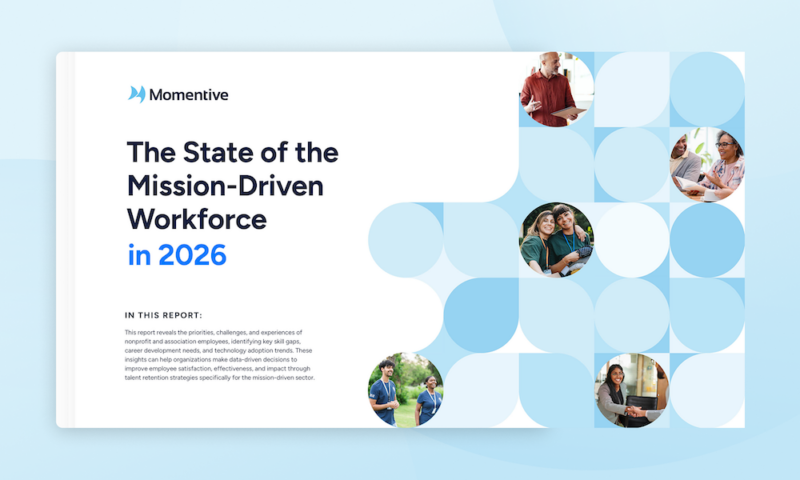
New research suggests this scenario is far more common than leaders realize. According to the “2026 State of the Mission-Driven Workforce” report commissioned by Momentive Software and conducted by Wakefield Research, 82 percent of mission-driven professionals say disconnected systems contribute to burnout. Among those experiencing technology-driven burnout, 63 percent are actively exploring other job opportunities.
The cost of a fragmented software stack is no longer abstract. It is showing up in resignations. Most organizations calculate the cost of a new platform. They rarely calculate the cost of the talent lost to the frustration of a broken one.
The Wrong Accounting
When association leaders evaluate whether to make technology investments, they tend to ask a familiar set of questions: Does the platform do what we need? Can we afford the license fee? Will staff adopt it? These are reasonable questions, but they are incomplete ones.
What is missing from this calculation is the workforce cost of the status quo. Keeping an outdated or fragmented system is not a neutral financial decision. It carries a cost that most organizations are not measuring: the cumulative toll of inefficiency on the people who absorb it every day.
The 2026 research data makes this toll concrete. Forty-eight percent of mission-driven professionals cite frustration with wasting time on repetitive tasks. Forty-six percent are frustrated that they must manually enter data across platforms. These are not minor inconveniences. They are the daily grind of working in an organization whose technology infrastructure has not kept pace with its people’s expectations—or their time.
And when staff reach their limit, they leave. The data shows that 63 percent of those experiencing technology burnout are actively looking for other opportunities. For context: Only 59 percent of the overall survey population is exploring other jobs. Technology burnout is not just a morale issue. It is a statistically meaningful predictor of departure.
A Compounding Problem
The workforce data surfaces one finding that deserves particular attention from senior leaders: 71 percent of employees experiencing technology burnout also lack clear career paths within their organizations.
These two deficits—inefficient tools and invisible growth trajectories—tend to occur together and reinforce each other in ways that are difficult to unwind. When staff spend significant time on manual, low-value work, they have less capacity to develop new skills, take on stretch assignments, or demonstrate the capabilities that would qualify them for advancement.
Conversely, when people cannot see a path forward, the frustrations of daily inefficiency feel less tolerable. Purpose and growth absorb a great deal of friction. When one is absent, the friction becomes more apparent—and more costly.
Leaders who are thinking about retention cannot address career development and technology in isolation. The data suggests they are part of the same problem.
What Integration Actually Changes
The case for integrated technology in associations has traditionally been made in operational terms: efficiency gains, reduced duplication, and better data. All of that is true and worth pursuing. But the workforce data invites leaders to think about integration through a different lens—one that accounts for what happens to people when systems work together versus when they do not.
Organizations that have invested in integrated platforms report meaningful workforce outcomes alongside operational ones. Leaders in the survey project strong returns from connected systems, including reduced burnout (73 percent), more time for mission-critical work (76 percent), and improved operational efficiency (76 percent). The relief that staff experience when they no longer must manually bridge disconnected systems is not incidental to mission delivery—it is part of it.
A few patterns emerge consistently when technology modernization goes well. The first is what I’d call the reclamation of intentional time. Association leaders frequently describe a version of the same phenomenon: Before modernizing their technology infrastructure, staff energy was quietly consumed by the systems themselves. Their day-to-day was filled with manually compiling program data for board reports, reentering information across platforms that didn’t communicate, or spending hours every week on administrative coordination that existed only because the tools required it. When integrated systems absorb that overhead, staff have more hours for the work that drew them to the sector.
A second pattern is the redistribution of cognitive load. In associations managing member training and professional development programs, the administrative burden of running disconnected learning systems often falls on a small number of staff who become, in effect, full-time translators between platforms. They manage data handoffs, troubleshoot enrollment errors, and manually generate reports that should compile automatically. When those systems are integrated, that cognitive load redistributes. Staff who were previously consumed by operational maintenance can engage with program quality, member relationships, and the kind of strategic thinking that tends to be the first casualty of administrative overload.
A third pattern is subtler but perhaps most consequential for retention: integrated systems tend to make individual contributions visible in ways that fragmented ones do not. When data lives in silos, it is difficult to see clearly what any one person has accomplished or where they are developing. When systems talk to each other and reporting becomes coherent, managers suddenly have better information about program outcomes, operational improvements, and the staff members who are driving them. Visibility of that kind is what the workforce data identifies as one of the strongest retention levers in the sector. Technology, in other words, creates the conditions under which people can be seen.
However, it’s important to be aware that when technology is poorly chosen, inadequately implemented, or adopted without staff investment in the transition, it can produce its own forms of burnout—and the sector has plenty of cautionary examples of that, too. But when it goes well, the effect on the people doing the work is not just efficiency. It is restoration. And restoration, the data suggests, is what keeps people.
A Talent Lens for Technology Decisions
Here are three questions worth adding to the evaluation framework:
- What is this system costing us in staff time today, and what would that time be worth if redirected? Most organizations can quantify a software license. Fewer have calculated how many collective hours per week are lost to manual workarounds, duplicate data entry, or navigating between disconnected tools. Making that number visible changes the conversation.
- Is our technology environment contributing to burnout—and do we know it? Exit interview data and engagement surveys rarely ask specifically about technology friction. Adding that question creates a data point that many organizations currently lack. You cannot address a problem you are not measuring.
- Would investing in this platform free our staff to do the work that develops them? Technology that reduces low-value task burden creates space for learning, stretch assignments, and the kind of visible contribution that supports career growth. Framing a technology investment in these terms connects it explicitly to the workforce outcomes boards care about.
This is not an argument for technology investment as a cure-all. Poorly chosen or implemented platforms create their own forms of burnout and frustration. The argument is for rigor—that the decision to invest in, maintain, or replace a system should account for its workforce effects alongside its operational ones.
Taking the Conversation Further
The findings from the “2026 State of the Mission-Driven Workforce” report will be the subject of a dedicated session at the ASAE Annual Meeting & Exposition in Indianapolis on Sunday, August 16 at 1:30 p.m. Your Staff Believes in the Purpose. So Why Are They Looking for the Door? will bring the research to life through practitioner-led conversation with association executives who have faced these challenges directly—moving from data to decisions leaders can act on immediately.
The session is designed for association leaders with responsibility for staff development and retention with a focus on the three factors the research identifies as having the strongest measurable impact on keeping people: career path clarity, technology that enables rather than exhausts, and the “belonging” advantage that associations are uniquely positioned to leverage. For leaders who are ready to move from recognizing the problem to solving it, this session offers a practical starting point.